
HOL Guard
A local security layer for AI agents that blocks secret reads, destructive commands, and risky tool use before execution.
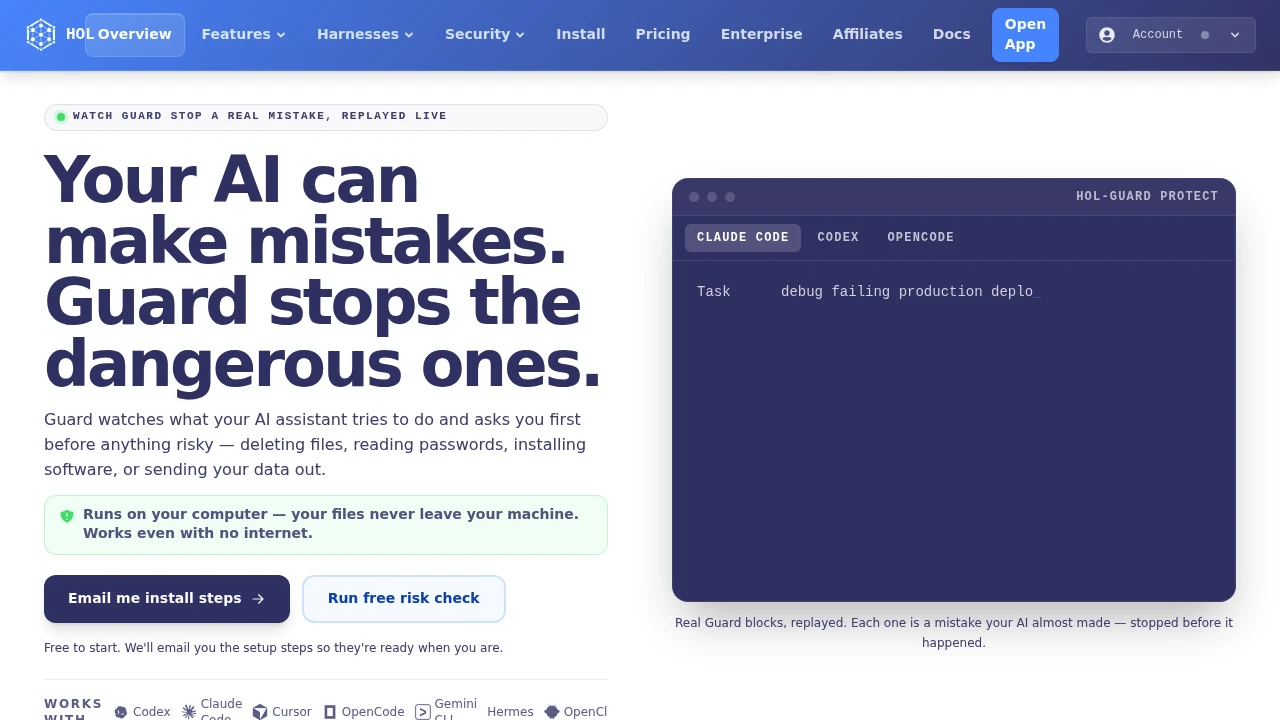
HOL Guard is a local security layer that sits between AI agents and the tools they want to use. It pauses risky actions before execution, allowing developers to approve or deny operations such as shell commands, secret reads, and MCP changes.
It is designed for developers who use coding agents on real development machines and want more control over what those agents can access or modify. Guard runs locally, keeps files on the machine, and can operate without an internet connection, while normal actions can continue without unnecessary interruptions.
Key Features
Risk Checks
Identify potentially dangerous actions before they execute.
HOL Guard can block or flag activities such as:
- Destructive shell commands
- Credential reads
- Secret exfiltration
- Suspicious package installations
- Unsafe agent actions
- Risky MCP changes
This creates a control point between the agent's request and the actual execution.
Local Enforcement
Keep the core protection on the development machine.
Guard operates on-device and does not require a cloud service to enforce its blocking and approval controls. This allows supported agent workflows to remain protected even when internet access is unavailable.
Approval Flow
Review ambiguous or risky actions before they happen.
When an action requires additional scrutiny, Guard can pause execution and ask for approval. Developers can then decide whether the requested operation should proceed.
AI Agent Support
Add a control layer around supported coding agents.
HOL Guard works with tools including:
- Codex
- Claude Code
- Cursor
- OpenCode
- Gemini CLI
- Hermes
- OpenClaw
- GitHub Copilot CLI
This makes it useful for developers who rely on AI assistants that can access files, execute commands, or interact with external tools.
Local Evidence
Keep a record of agent decisions and changes.
Guard maintains a local decision trail showing what actions were approved and what changes occurred, giving developers a way to review agent activity after the fact.
Guard Cloud
Extend local protection with optional shared controls.
Guard Cloud adds features such as:
- Shared policies
- Team dashboards
- Evidence export
- Centralized visibility
Local enforcement remains active on individual machines, while Cloud provides additional team-level management and visibility.
Maintainer Scanner
Check plugins, extensions, and MCP configurations for security concerns.
The maintainer scanner can inspect repositories for issues involving plugin configuration, manifests, and MCP security posture. It can also be integrated into CI workflows to help gate changes before they are released.
Built for Safer AI Agent Workflows
HOL Guard is designed for development environments where AI agents have meaningful access to a computer and its tools.
Key benefits include:
- Intercept risky agent actions
- Block destructive commands
- Protect credentials and secrets
- Review MCP changes
- Detect unsafe package activity
- Require approval for ambiguous actions
- Keep enforcement local
- Maintain local evidence
- Support multiple coding agents
- Scan plugins and extensions
- Check MCP security posture
- Gate changes through CI
- Add shared policies with Guard Cloud
Built For
- Developers
- Software Engineers
- DevOps Engineers
- AI-Assisted Developers
- Coding-Agent Users
- Open-Source Maintainers
- Security-Conscious Teams
- Engineering Teams
Common Use Cases
- Protecting AI coding agents
- Controlling shell commands
- Preventing destructive agent actions
- Protecting credentials from agent access
- Reviewing secret reads
- Controlling MCP tool changes
- Detecting prompt-injection risks
- Checking plugins before release
- Scanning extensions
- Reviewing repository security posture
- Gating risky changes in CI
- Managing AI agent policies across teams
Why It Matters
AI coding agents can be useful precisely because they can interact with the development environment. The same access can create risks when an agent encounters a malicious instruction, attempts to access credentials, runs a destructive command, or interacts with an unsafe tool.
HOL Guard adds a control layer between the agent and those actions. Each supported action can be evaluated before execution, allowing ordinary work to continue while potentially dangerous operations are blocked or sent through an approval flow.
The local-first approach is also important for developers who do not want their core enforcement layer dependent on a cloud service. Files remain on the machine, and Guard can operate without internet access while maintaining a local record of decisions and changes.
For maintainers, the scanner extends that protection beyond day-to-day agent use. Repositories, plugins, manifests, and MCP configurations can be checked before changes are released, with CI support for teams that want security checks incorporated into their development process.
Teams can add Guard Cloud when they need shared policies, dashboards, and evidence export, while local enforcement continues to protect each individual development environment.
Add a Local Control Layer to AI Agents With HOL Guard
Put a security checkpoint between AI agents and the tools they use. HOL Guard provides local risk checks, approval controls, agent support, evidence tracking, and maintainer scanning to help developers control shell commands, secrets, MCP tools, plugins, and other potentially risky agent actions.