
Pallix
Monitor how brands appear in AI answers, trace the sources behind those answers, and spot competitor and content gaps.
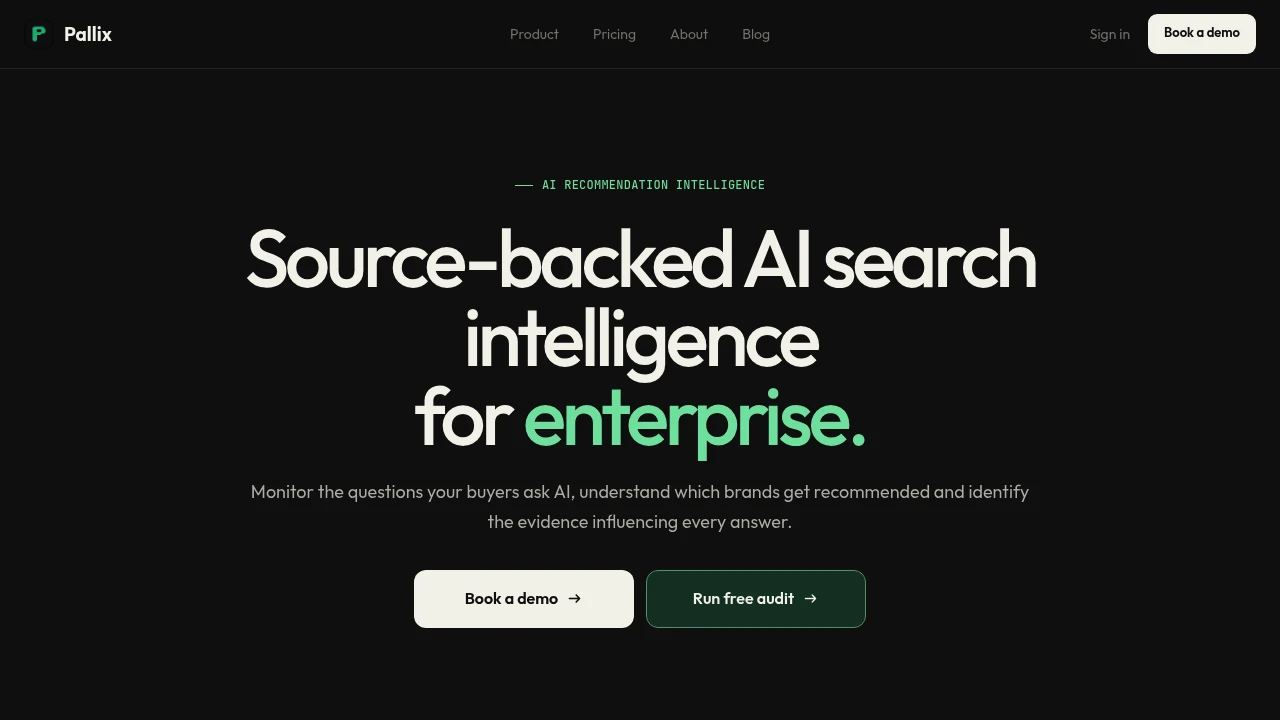
Pallix is an AI search visibility platform that helps marketing teams understand how their brand appears across AI-powered search engines and recommendation systems. It monitors responses from ChatGPT, Perplexity, Gemini, Google AI, and Copilot, then connects those answers to the sources, competitors, market signals, and gaps influencing brand visibility.
The platform is designed for brands, agencies, founders, freelancers, and marketing teams that want to treat AI visibility as an actionable marketing channel. Instead of showing a single visibility score without context, Pallix helps teams examine the questions buyers ask, understand why certain brands are recommended, identify missing evidence or source gaps, and prioritize actions that may improve their presence over time.
Key Features
AI Search Visibility Tracking
Monitor how your brand appears across major AI search and recommendation platforms.
Pallix tracks visibility across:
- ChatGPT
- Perplexity
- Gemini
- Google AI
- Microsoft Copilot
The platform focuses on selected prompts and buyer questions to help teams understand how often their brand appears and how its visibility changes over time.
Brand Mention Analysis
Measure how AI systems represent and recommend your brand.
Pallix can track signals such as:
- Mention rate
- Sentiment
- Recommendation share
- Overall visibility
- Prompt-level performance
- Competitor presence
This helps teams understand not only whether a brand appears, but also how it is positioned within AI-generated answers.
Citation Intelligence
Trace AI-generated answers back to the sources influencing them.
Pallix maps evidence such as:
- Referenced domains
- Specific URLs
- Online communities
- Supporting sources
- Competitor sources
- Missing evidence
This gives marketing teams more context around why an AI system recommends one brand while excluding another.
Source and Evidence Analysis
Identify gaps in the information supporting your brand's AI visibility.
The platform can help surface:
- Missing source coverage
- Weak evidence
- Authority gaps
- Competitor-backed sources
- Relevant communities
- Sources influencing recommendations
This creates a clearer connection between AI answers and the evidence available across the web.
Competitor Visibility Monitoring
Track how competing brands appear in the same AI-generated answers.
Analyze signals such as:
- Competitor mentions
- Recommendation share
- Visibility changes
- Prompt coverage
- Source advantages
- Market presence
This can help teams identify situations where competitors are gaining visibility while their own brand is missing from relevant buyer questions.
Market Signal Analysis
Look beyond traditional websites to understand the wider signals influencing recommendations.
Pallix incorporates market signals from sources such as:
- Editorial publications
- YouTube
- Marketplaces
- Reputation sources
- Online communities
This gives teams a broader view of the sources and discussions that may shape how brands are represented in AI-generated recommendations.
Prioritized Visibility Fixes
Turn AI visibility findings into actionable next steps.
The platform can surface gaps involving:
- Content
- Authority
- Technical setup
- Source coverage
- Crawler access
- Supporting evidence
Recommended actions are prioritized based on potential impact, helping teams focus on the issues that may matter most.
Technical Visibility Analysis
Identify technical factors that may affect whether AI systems can access or use your content.
Pallix can highlight issues such as:
- Blocked crawler access
- Technical gaps
- Missing discoverability signals
- Content accessibility issues
This helps teams investigate whether visibility problems are caused by content and authority gaps or by technical barriers.
Local Market Analysis
Evaluate AI visibility across different markets and languages.
The platform can assess results based on:
- Country
- Language
- Local market context
- Market-specific sources
- Regional recommendation patterns
This can be useful for brands operating across multiple regions where the sources and recommendations influencing AI answers may differ.
Impact Measurement
Measure whether visibility changes after improvements are made.
Teams can compare performance:
- Before fixes
- After fixes
- Across selected prompts
- Against competitors
- Over time
This helps connect marketing actions with changes in AI search and recommendation visibility.
Answer-to-Action Workflow
Connect AI-generated answers directly to the evidence and actions behind them.
The Pallix workflow can move from:
- Buyer questions
- AI-generated answers
- Brand visibility analysis
- Source tracing
- Competitor comparison
- Gap identification
- Prioritized actions
- Impact measurement
This gives teams a structured path from identifying a visibility problem to understanding its potential causes and tracking what changes afterward.
Free AI Visibility Audit
Get a one-time snapshot of current AI visibility.
The free audit includes insights such as:
- Visibility score
- Missed prompts
- Competitor analysis
- Initial visibility gaps
- First areas to improve
This provides an entry point for teams that want to assess their current presence before moving to ongoing monitoring.
Ongoing Monitoring and Action Planning
Track AI visibility over time through the paid platform.
The ongoing workflow can support:
- Continuous monitoring
- New visibility findings
- Competitor changes
- Emerging source gaps
- Updated recommendations
- Running action plans
This makes it possible to treat AI search visibility as an ongoing marketing workflow rather than a one-time audit.
Built for AI Search and Recommendation Visibility
Pallix combines AI visibility monitoring, brand mention analysis, citation intelligence, competitor tracking, market signal analysis, technical visibility checks, prioritized recommendations, and impact measurement into one AI search optimization workflow.
Key benefits include:
- AI search visibility tracking
- Brand mention monitoring
- Recommendation share analysis
- Citation and source intelligence
- Competitor visibility tracking
- Market signal analysis
- Content and authority gap identification
- Technical visibility analysis
- Prioritized action planning
- Before-and-after impact measurement
Built For
- Marketing Teams
- SEO Teams
- Content Marketers
- Digital Agencies
- Brand Teams
- SaaS Founders
- Freelancers
- Growth Teams
- Multi-Market Businesses
Common Use Cases
- Tracking how a brand appears in ChatGPT and other AI platforms
- Monitoring AI-generated recommendations
- Identifying buyer prompts where a brand is missing
- Comparing AI visibility against competitors
- Tracing the domains and URLs behind AI answers
- Finding source and evidence gaps
- Identifying content opportunities
- Investigating blocked crawler access
- Analyzing AI visibility across different countries and languages
- Measuring whether visibility improves after marketing changes
- Building an ongoing AI search action plan
Why It Matters
Traditional search visibility is often measured through rankings, keywords, backlinks, and organic traffic. AI-powered search and recommendation systems introduce another layer where users ask direct questions and receive synthesized answers that may recommend brands without presenting a conventional list of search results.
This means a brand can perform well in traditional search while appearing inconsistently, or not appearing at all, when potential customers ask AI systems for recommendations. Understanding that problem requires more than a visibility score. Teams need to know which questions matter, which competitors appear, what sources support those recommendations, whether important evidence is missing, and what actions may improve future visibility.
Pallix connects those pieces into a single workflow. Teams can monitor AI answers, trace the sources and communities behind recommendations, identify competitor advantages and visibility gaps, prioritize content, authority, or technical improvements, and measure whether those changes affect how the brand appears over time.
Monitor, Analyze, Improve, and Measure AI Brand Visibility From One Platform
Track how your brand appears across ChatGPT, Perplexity, Gemini, Google AI, and Copilot, analyze brand mentions and recommendation share, trace the domains and URLs influencing AI answers, monitor competitors and market signals, identify content, authority, and technical gaps, prioritize next actions, and measure how AI visibility changes after improvements through one centralized AI search visibility platform.