
ProviderBench
A benchmark site for LLM inference providers with same-model comparisons for latency, price, reliability, and model coverage.
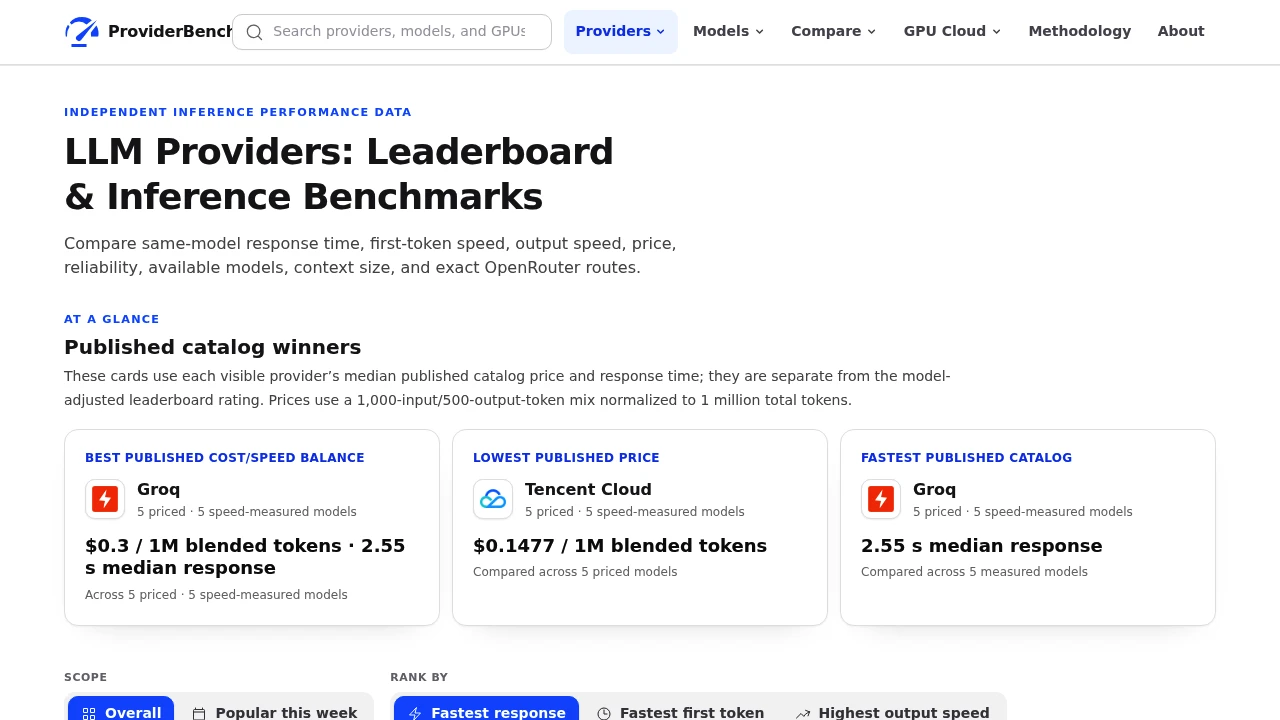
This site compares LLM inference providers running the same models, giving teams a way to evaluate where a model runs rather than looking only at model-level performance. It is designed for developers and teams choosing between inference providers, GPU clouds, or specific routes who want a practical view of speed, cost, reliability, and model coverage before putting their own traffic through an endpoint.
The rankings bring performance, pricing, uptime, and coverage into the same view. By separating response start time from token generation speed and requiring shared-model measurements for comparable scores, the benchmark helps distinguish genuinely comparable provider performance from entries where the available data is thinner.
Key Features
Same-Model Benchmarking
Compare providers running identical models.
Using the same model across providers makes it easier to evaluate differences attributable to the inference provider rather than differences between model capabilities.
This provides a practical basis for comparing:
- Inference speed
- Provider routes
- GPU infrastructure
- Performance consistency
Multiple Speed Metrics
The benchmark separates different parts of the response experience rather than reducing performance to one speed number.
It tracks:
- Response time
- First-token speed
- Output token speed
This distinction matters because different workloads optimize for different things. For interactive chat, response start time can have a major impact on perceived responsiveness, while longer generations may make sustained output speed more important.
Pricing Context
Compare provider performance alongside published pricing.
The benchmark includes:
- Published catalog price
- Blended token pricing
- Cost context alongside performance
This makes it easier to identify cases where a low advertised rate may come with slower inference or weaker overall performance.
Reliability Signals
Uptime is shown alongside speed and pricing.
Rather than evaluating an endpoint purely on how quickly it responds, teams can also consider whether the provider has demonstrated reliable availability.
This gives the leaderboard a broader operational perspective for teams deciding where production inference should run.
Provider And Route Coverage
Review what each provider actually supports.
Coverage information includes:
- Available models
- Context size
- Exact OpenRouter routes
This helps teams determine not only which provider ranks well, but whether the provider actually supports the model and context requirements of their workload.
Ranking Rules
The rankings distinguish between directly comparable measurements and thinner datasets.
For comparable scores, the benchmark requires shared-model measurements across providers. This prevents providers from being ranked as though they had equivalent evidence when there is no common model data.
Entries with limited data are treated more cautiously.
This makes the leaderboard useful as a comparative benchmark without implying that every provider row has the same level of measurement coverage.
Provider-Specific Models
The benchmark also keeps providers that primarily offer their own models in the broader view.
When direct shared-model comparison is not possible, the site uses the provider's published catalog speed.
This allows the leaderboard to remain useful as a broader provider directory while making the distinction between directly benchmarked results and provider-published performance visible.
Built For LLM Infrastructure Decisions
AI Engineering Teams
Compare inference providers before deciding where production workloads should run.
Developers
Evaluate routes based on response speed, generation speed, price, and availability.
AI Infrastructure Teams
Compare GPU-backed inference options without relying on a single performance metric.
Teams Evaluating Providers
Shortlist providers based on the combination of model coverage, cost, speed, and uptime before conducting their own traffic tests.
Common Use Cases
Choosing An Inference Provider
Compare multiple providers running the same model to identify meaningful performance differences.
Optimizing Chat Responsiveness
Focus on response start time and first-token speed when interactive latency matters most.
Evaluating Generation Throughput
Use output token speed when longer completions make sustained generation performance more important.
Comparing Cost And Performance
Look at pricing alongside speed to avoid selecting an endpoint solely because its published token rate is lower.
Checking Provider Reliability
Use uptime alongside performance and cost when evaluating potential production infrastructure.
Comparing OpenRouter Routes
Review exact routes, supported models, and context sizes when deciding between available inference paths.
Broader Provider Coverage
The leaderboard is not limited to providers that can be directly compared on every model. Providers with proprietary or otherwise unique models can still appear using published catalog speed where direct benchmarking is unavailable.
The distinction is important: not every ranking represents the same measurement basis. Shared-model results provide the stronger basis for direct provider comparisons, while provider-specific entries provide broader coverage with less directly comparable evidence.
Why It Matters
Choosing an inference provider is not simply a matter of finding the fastest model. The same model can behave differently depending on where it is hosted, which route serves it, and how reliable that endpoint is.
This benchmark brings those provider-level variables into one comparison. Response latency, first-token speed, output throughput, pricing, uptime, model coverage, context size, and routing information can be evaluated together instead of being gathered from separate provider pages.
The result is a more practical way to shortlist inference infrastructure while keeping the limitations of the underlying measurements visible.
Compare Where Your Models Run
Evaluate LLM inference providers using the same models and compare response time, first-token speed, output speed, pricing, uptime, model coverage, context size, and exact routes. With shared-model ranking rules and more cautious treatment of thin data, the benchmark provides a practical starting point for choosing inference infrastructure before testing with your own traffic.


