
Qeemah
Cloud accounting software for Saudi and UAE businesses with ZATCA workflows, UAE e-invoicing readiness, VAT, inventory, payroll, and reporting.
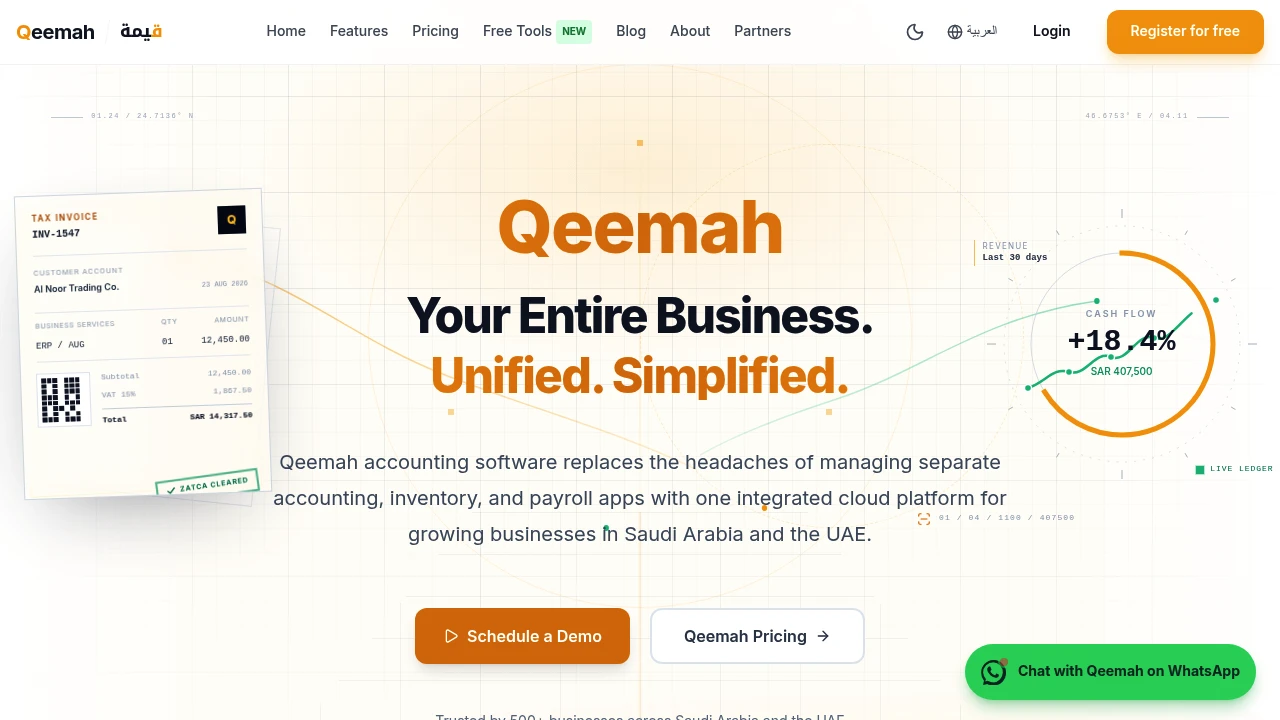
Qeemah is cloud accounting software built for businesses operating in Saudi Arabia and the UAE. It brings accounting, inventory, payroll, and financial reporting into one platform, helping businesses manage finance and operations without relying on separate systems for bookkeeping, stock management, and payroll.
The platform is designed around the requirements of Gulf businesses, with support for Saudi ZATCA workflows and UAE e-invoicing readiness. It fits companies that invoice regularly, manage inventory across multiple warehouses or locations, or need clearer visibility during month-end close across branches and entities.
Key Features
Sales & Purchases
Manage core sales and purchasing activity from one accounting system.
Businesses can create and track:
- Sales invoices
- Purchase orders
- Payments
- Transaction history
Keeping these transactions connected provides finance teams with a centralized view of day-to-day business activity.
Multi-Warehouse Inventory
Track inventory across multiple warehouses and locations while keeping stock movements connected to accounting records.
This makes it easier for businesses with distributed inventory to understand what is in stock while maintaining aligned financial records.
Localized Payroll
Run payroll within the same platform used for accounting and operations.
Qeemah also supports end-of-service calculations, helping businesses manage localized payroll requirements alongside their other financial workflows.
Financial Reporting
Review financial performance without moving information between separate applications.
Reporting includes:
- Profit and loss
- Balance sheets
- Cash flow
- Financial reports
- Expense breakdowns
- Sales trends
This gives finance teams and business owners a centralized view of financial activity and performance.
Audit Trail & Role-Based Access
Maintain a full transaction history across the accounting system.
Role-based access helps businesses control who can access different parts of their financial and operational information, while the transaction trail provides visibility into activity for audit and review purposes.
Saudi & UAE Compliance
Qeemah is designed around local compliance requirements in Saudi Arabia and the UAE.
The platform supports:
- Saudi VAT workflows
- ZATCA workflows
- UAE VAT
- UAE e-invoicing readiness
This makes compliance part of the accounting workflow rather than something businesses have to manage separately from their daily financial operations.
Built For Growing Gulf Businesses
Qeemah is designed for companies operating across Saudi Arabia and the UAE, particularly businesses that are growing beyond spreadsheets and disconnected finance tools.
It can fit:
- Finance managers
- Accountants
- Controllers
- Business owners
- Companies managing multiple branches
- Businesses operating across multiple entities
- Companies managing inventory across warehouses
Common Use Cases
Managing business accounting: Keep invoices, payments, purchases, transactions, and financial records in one cloud platform.
Multi-location inventory: Track stock across multiple warehouses while keeping inventory movements aligned with accounting.
Running payroll: Manage localized payroll and end-of-service calculations alongside accounting records.
Month-end close: Bring accounting, sales, expenses, inventory, and payroll information into one system to improve financial visibility.
Managing multiple entities: Keep books and operational records aligned across branches or entities.
Monitoring business performance: Review sales trends, expenses, cash flow, profit and loss, and other financial information from one place.
Handling Gulf tax requirements: Manage Saudi VAT and ZATCA workflows alongside UAE VAT and e-invoicing readiness.
Tracking stock levels: Use inventory visibility and low-stock alerts to stay informed about operational requirements.
Operational & Financial Visibility
Qeemah connects accounting data with day-to-day business operations, giving teams visibility beyond basic bookkeeping.
Finance and operational teams can monitor sales trends, expense breakdowns, low-stock alerts, and recent activity while keeping those workflows connected to the company's financial records.
This is particularly useful for businesses managing branches, warehouses, or multiple entities where disconnected systems can make it harder to maintain consistent information.
Why It Matters
Growing businesses often end up combining spreadsheets, accounting software, inventory systems, and payroll tools to manage different parts of their operations. This can create gaps between financial records and what is actually happening across sales, stock, and employees.
Qeemah takes a unified approach by bringing accounting, inventory, payroll, reporting, and compliance into one cloud platform. Its focus on Saudi and UAE requirements also means businesses can manage local tax and invoicing workflows within the same environment as their everyday financial operations.
For finance managers, accountants, controllers, and owners, the result is a more centralized view of books, stock movements, payroll entries, and business performance.
Manage Gulf Business Finance With Qeemah
Qeemah combines accounting, sales, purchases, inventory, payroll, reporting, audit controls, and Saudi and UAE compliance workflows in one cloud platform. Built for businesses operating across the Gulf, it provides a connected system for managing finance and operations across branches, warehouses, and entities.