
Qualra
A customer memory layer for product teams that stores past chats, groups recurring issues, and follows up on shipped fixes.
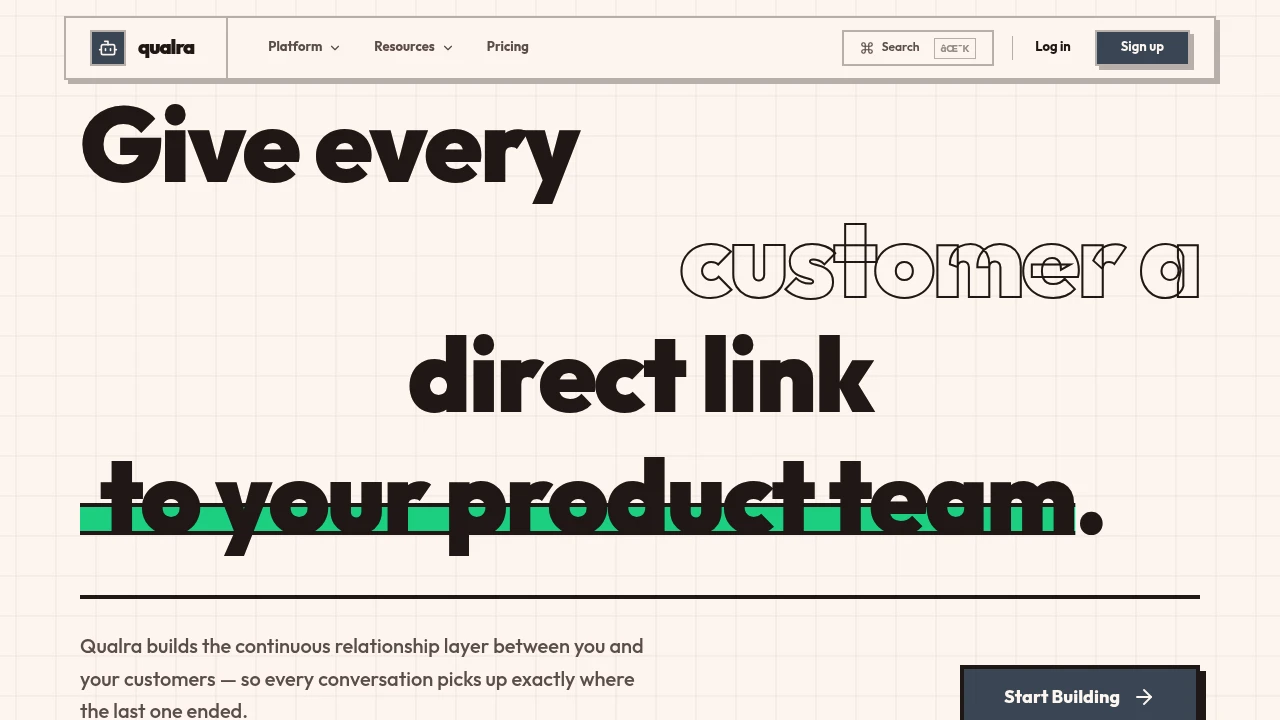
Qualra helps product teams maintain a continuous relationship with customers instead of treating every conversation as a one-off interaction. It keeps past chats, customer requests, and friction points as shared context, so teams can understand what has already been discussed without asking customers to repeat themselves.
The platform starts conversations across channels customers already use, including web, Slack, and email. It then carries that context into future touchpoints, identifies recurring patterns across accounts, and connects customer insights back to the product work they inform.
Key Features
Persistent Customer Memory
Qualra keeps previous customer conversations, requests, and friction points in one place.
This gives product teams a shared history they can refer back to when continuing conversations or investigating recurring customer problems.
Context-Aware Follow-Up
Follow-up conversations are informed by what customers have already said.
Instead of restarting the conversation from scratch, Qualra can ask natural follow-up questions based on previous interactions and maintain continuity across touchpoints.
Cross-Account Pattern Finding
Qualra looks across customer accounts to identify recurring themes and friction points.
This helps teams move beyond individual feedback and understand which problems are appearing repeatedly across their customer base.
Evidence-Backed Insights
Recurring issues are accompanied by supporting customer quotes.
Teams can therefore connect a broader pattern back to the conversations and feedback that provide evidence for it.
Closing the Customer Feedback Loop
Qualra can follow up with customers after relevant product updates ship.
This allows teams to reconnect changes to the customers whose feedback contributed to them, rather than letting feedback disappear after it has been collected.
Product Tool Handoff
Customer insights can be mapped into existing development workflows through integrations with:
- Linear
- GitHub
This helps connect customer feedback with the work teams are already tracking.
PostHog Telemetry Context
Qualra can connect session telemetry through PostHog, adding product usage context to customer conversations and feedback.
This provides another layer of information when teams are trying to understand the circumstances around a customer issue.
Built For Product Teams
Qualra is designed for teams that want customer feedback to remain useful and accessible over time.
It can be useful for:
- Product teams
- Product managers
- Customer research teams
- Customer-facing product organizations
- Teams managing feedback across multiple accounts
- Companies connecting customer insights to engineering work
Common Use Cases
Continuous customer research: Maintain conversations over time instead of treating each research interaction as an isolated response.
Feedback analysis: Identify recurring themes and friction points across multiple customer accounts.
Customer follow-up: Continue conversations with context from previous interactions.
Evidence-based product decisions: Connect recurring issues with the customer quotes supporting them.
Closing the loop: Re-engage customers when related product improvements are shipped.
Product development: Map customer insights into Linear or GitHub so feedback can become part of the development workflow.
Behavior-informed research: Add PostHog session telemetry to customer context when investigating product issues.
Conversations Across Existing Channels
Qualra starts customer conversations where teams and customers already communicate.
Supported touchpoints include:
- Web
- Slack
The important part is what happens after the initial conversation. Previous interactions remain available as context, allowing later conversations to build on what has already been discussed rather than starting from a blank slate.
Collins AI Research Assistant
Qualra also includes Collins, an AI research assistant that powers live research chats.
Collins supports the conversational side of customer research while Qualra's broader system keeps the resulting context connected to accounts, recurring themes, evidence, and product work.
From Feedback to Product Work
Customer feedback often loses value when it remains scattered across surveys, chat threads, emails, and internal notes. Qualra is designed to keep that context connected.
A customer can share a problem, the issue can be identified as part of a broader pattern, supporting evidence can be attached, and the resulting insight can be mapped into Linear or GitHub. When the related update ships, Qualra can follow up with the customer and continue the conversation.
This creates a more connected path between customer conversation, product insight, engineering work, and follow-up.
Pricing
Qualra includes the first 100 conversations free, providing a simple way for teams to start using the platform before expanding their customer research workflow.
Why It Matters
Product teams need customer feedback to remain useful after the original conversation ends. When context is scattered across different channels, customers may have to repeat themselves and product teams can struggle to distinguish isolated requests from recurring problems.
Qualra approaches feedback as an ongoing relationship. Persistent memory, context-aware follow-ups, cross-account pattern finding, supporting evidence, product tool handoffs, and post-launch follow-up help keep customer context attached to the work it influences.
Keep Customer Context Connected With Qualra
Turn individual customer conversations into durable product context with persistent memory, AI-powered research chats, recurring pattern detection, evidence-backed insights, product workflow integrations, and customer follow-up. Qualra gives product teams a way to keep the conversation going while connecting customer feedback to the work that follows.