
supastarter
A production-ready Next.js SaaS starter kit with auth, billing, orgs, i18n, API, and AI workflow foundations.
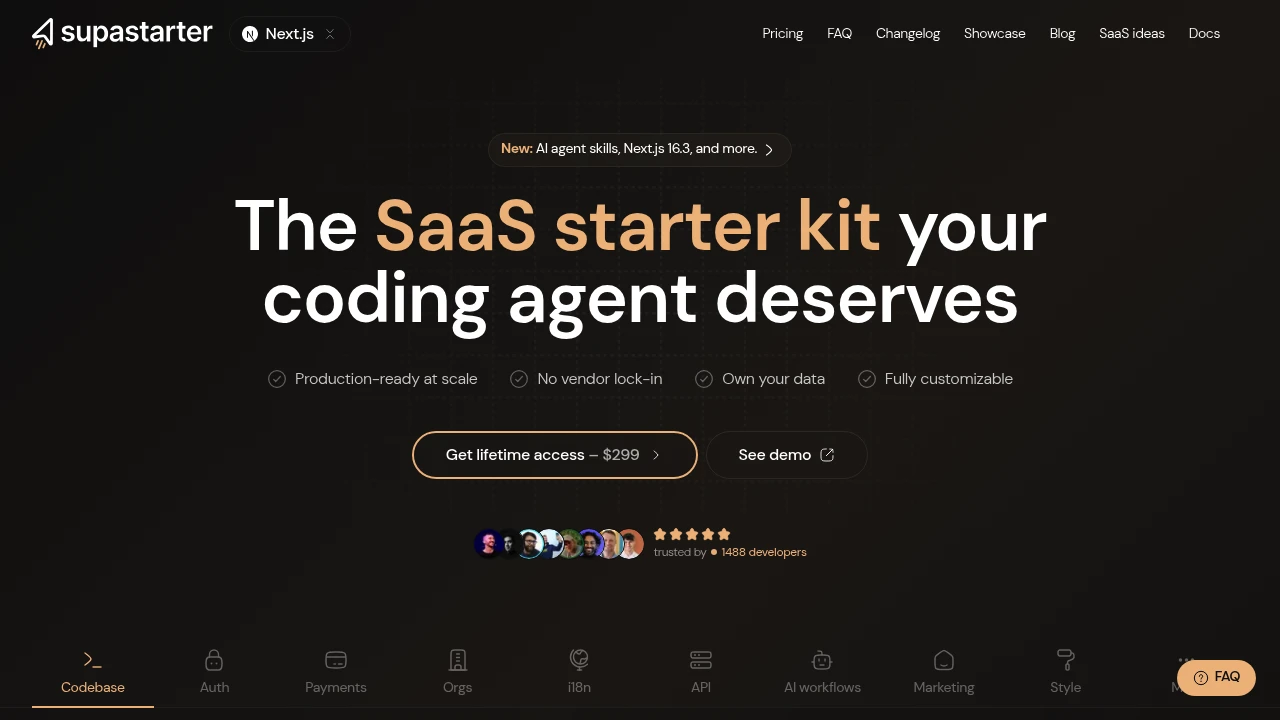
This SaaS starter kit gives teams building with Next.js, React, and TypeScript a production-shaped foundation with the common pieces of a modern SaaS application already structured and modeled. Instead of repeatedly wiring authentication, billing, organizations, APIs, AI, marketing pages, and supporting infrastructure, teams can start from an established codebase and focus on building their product.
Designed for founders, indie hackers, agencies, and product teams, the starter provides ownership of the underlying code and data while giving developers a maintainable starting point for a real application. Its structured monorepo, AGENTS.md, and Agent Skills support also make it easier for coding agents to extend the existing architecture without inventing a new project structure.
Key Features
Complete Authentication System
The starter includes a broad authentication foundation for applications that need more than basic email and password login.
Authentication features include:
- Password authentication
- Passkeys
- Magic links
- OAuth
- Two-factor authentication
- Roles and permissions
- User impersonation
This gives teams a ready-made foundation for both simple and more advanced account access requirements.
SaaS Billing and Payments
Billing functionality is already modeled for common SaaS monetization approaches.
The starter supports:
- Checkout
- Webhooks
- Subscriptions
- One-time payments
- Usage-based billing
- Seat-based billing
Teams can build their pricing and payment flows on top of these existing patterns instead of implementing the billing foundation from scratch.
Organizations and Multi-Tenancy
The organizations layer supports SaaS products where multiple users and teams need to work within separate spaces.
Features include:
- Organization creation
- Member invitations
- Member roles
- Multi-tenant application structure
This provides a foundation for products serving teams, businesses, and multiple customer organizations.
Typed API and Data Layer
The codebase includes structured data and API foundations designed for maintainable application development.
It covers:
- Typed data access
- Permissions
- Database migrations
- OpenAPI support
- Reusable API clients
These pieces help teams keep data access and application interfaces organized as the product grows.
Internationalization
The starter includes internationalization support for applications that need multiple languages.
It provides:
- Locale support
- Language switching
- Translatable email templates
This gives teams a starting point for expanding their application beyond a single language.
AI Workflow Foundation
AI functionality is included as part of the starter rather than treated as a completely separate project.
The kit includes:
- A chatbot example
- Multiple AI adapters
- Structured AI workflow foundations
Teams can use these pieces as a starting point for adding AI-powered features to their own SaaS products.
Marketing and SaaS UI
The starter also includes common customer-facing pages and interface components needed around a SaaS product.
These include:
- Landing pages
- Pricing sections
- Newsletter signup
- Dark mode
- Mobile-first styling
- shadcn/ui compatibility
This allows teams to work from an existing product and marketing interface rather than beginning with an empty application.
Transactional Email, Storage, and Notifications
The foundation extends beyond the core application into supporting SaaS infrastructure.
It includes patterns for:
- Transactional email
- File storage
- Notifications
- Onboarding
- SEO
These are the surrounding systems that often require significant implementation time when assembling a SaaS product from scratch.
Docs, Blog, and Legal Pages
The starter also provides content and product-support structures for a complete SaaS website.
Included areas cover:
- Documentation
- Blog
- Legal pages
This makes the starting codebase suitable for products that need both an application and a public-facing web presence.
Monitoring and Testing
Production-oriented tooling is included for maintaining application quality.
The starter covers:
- Monitoring
- End-to-end testing
- Local development
- Docker Compose
This gives teams a more complete development environment for building and testing the application before deployment.
Deployment Support
Deployment documentation and configurations support several common environments.
The starter includes guidance for:
- Vercel
- Serverless deployments
- Docker
- Environment configuration
This gives teams flexibility in how they deploy and operate the application.
Structured Monorepo and Agent Support
The codebase is organized as a structured monorepo with separate apps and shared packages. SaaS-specific areas such as authentication, billing, organizations, and administration are already separated into reusable parts.
AGENTS.md and Agent Skills support provide additional structure for coding agents working inside the repository. Instead of generating an unrelated architecture, agents can extend the existing project conventions and shared packages.
Built For SaaS Teams
This starter kit is designed for founders, indie hackers, agencies, and engineering teams who want to move quickly while keeping control of their application's source code and data.
It is particularly useful for teams building subscription products, multi-tenant applications, AI-powered SaaS products, internal tools that may become commercial products, and other applications requiring a production-oriented foundation.
Common Use Cases
- Launching a SaaS product: Start with authentication, billing, organizations, UI, and infrastructure already structured.
- Building a multi-tenant app: Use organizations, invitations, roles, and permissions as the application foundation.
- Subscription products: Build on existing checkout, subscriptions, webhooks, and billing patterns.
- Usage-based SaaS: Extend the included usage-based billing foundation.
- AI SaaS: Start from the chatbot example and AI adapter architecture.
- Agency projects: Use a reusable foundation across multiple client SaaS applications.
- Rapid MVP development: Spend less time rebuilding standard SaaS infrastructure.
- Agent-assisted development: Give coding agents an established project structure through AGENTS.md and Agent Skills.
- Production applications: Start with testing, monitoring, deployment, documentation, and other supporting systems already considered.
Why It Matters
Building a SaaS product involves far more than creating its core feature. Authentication, billing, organizations, permissions, email, storage, notifications, testing, deployment, documentation, and marketing pages can consume significant development time before the actual product work begins.
This starter kit brings those surrounding pieces into a structured Next.js, React, and TypeScript codebase. Its monorepo architecture separates applications and shared packages, while the included SaaS folders give teams established foundations for areas such as auth, billing, organizations, and administration.
The addition of AGENTS.md and Agent Skills support also makes the architecture easier for coding agents to work with, allowing them to extend existing patterns instead of creating disconnected implementations.
Build Your SaaS on a Production-Shaped Foundation
Start with a structured Next.js, React, and TypeScript codebase covering authentication, billing, organizations, APIs, AI workflows, marketing UI, testing, deployment, and the supporting infrastructure around a modern SaaS product. Focus your development time on what makes your product different instead of rebuilding the same foundation for every project.