
Verifier
Independent rankings of AI tools and related software, checked against pricing pages, licence files, and public measurements.
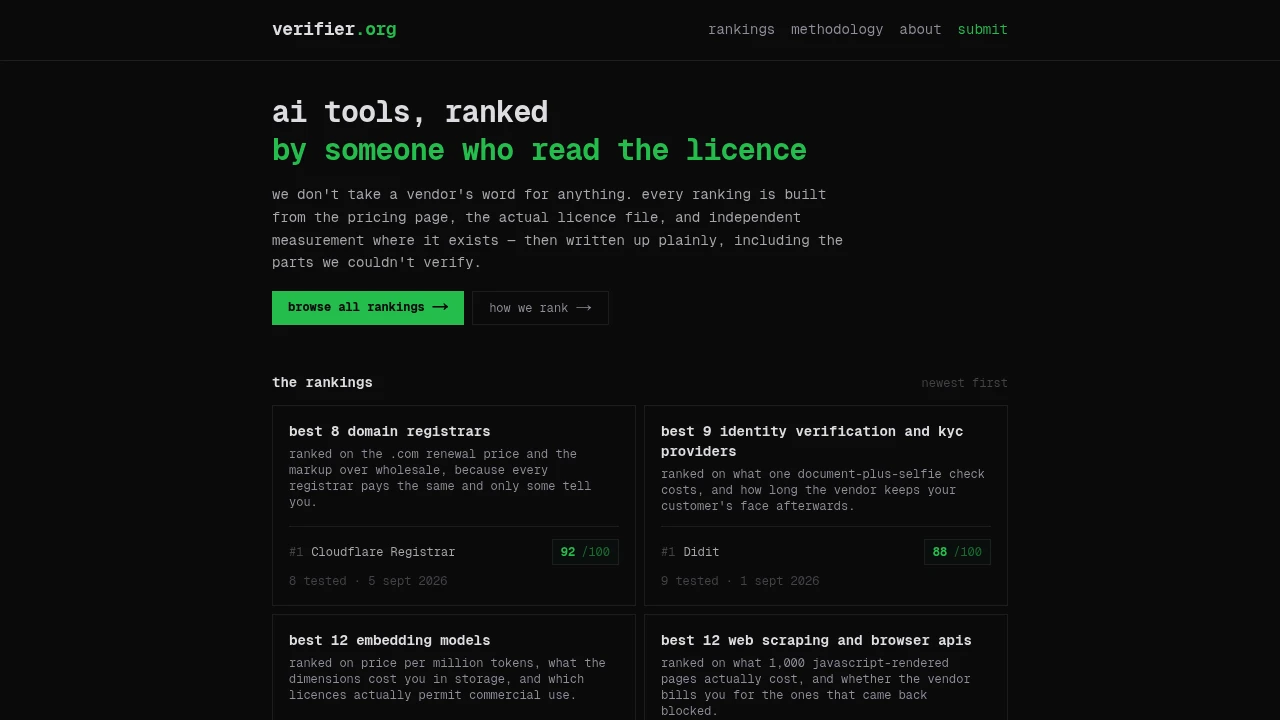
Compare AI tools, agents, and supporting software through research grounded in primary sources rather than vendor copy. Each entry is reviewed using pricing pages, licence files, product documentation, and, where available, credible independent measurements such as public leaderboards and published adoption figures.
The focus is practical: understanding what can actually be verified before choosing a product. Rankings consider both capabilities and the factors that affect real-world value, including reliability, latency, support, failure modes, realistic cost, licensing, APIs, and long-term viability.
Key Features
Primary-Source Research
Each product starts with the sources closest to the product itself. Pricing pages, licence files, and official documentation are reviewed directly to establish what can be verified.
- Pricing and plan information
- Product documentation
- Actual licence files
- Vendor-provided technical information
- Independent measurements where credible sources exist
Licence Reporting
Licensing can materially change the value and usability of software. Each entry reports the licence found during review and flags contradictions between the licence and other vendor materials when they appear.
Practical Ranking Criteria
Rankings look beyond feature lists. Products are evaluated using the factors that matter when actually selecting and operating a tool.
- Capability
- Reliability
- Latency
- Support
- Failure modes
- Realistic cost
- Licensing and restrictions
- API availability
Viability Factors
A product's current feature set is only part of the decision. Factors that could affect whether it remains useful are also considered.
Shutdowns, restrictive licences, missing APIs, and other limitations can lower a product's ranking when they materially affect its viability.
Category-Specific Scores
Scores are designed for meaningful comparisons within a category. A product's score should not be interpreted as a universal ranking against every other product on the site.
This keeps category rankings focused on the tools people are actually choosing between.
Transparent Money Disclosure
Advertising and some affiliate relationships may exist, but they do not determine rankings or editorial copy. The goal is to keep commercial relationships separate from product evaluation.
Built For People Choosing Software
The site is designed for people who need to compare tools, products, and platforms where pricing, licensing, technical limitations, and product changes can quickly affect their decision.
It is particularly useful for:
- AI tool and agent comparisons
- Software selection
- Developer and technical tooling research
- Productivity software
- Operational platforms
- Products with complex licensing or pricing
- Tools where independent measurement is available
Common Use Cases
Comparing AI Tools
Evaluate competing AI products based on verifiable capabilities, costs, limitations, reliability, and other practical considerations rather than relying solely on marketing claims.
Evaluating AI Agents and Platforms
Compare agents and the software around them while considering APIs, failure modes, support, licensing, and long-term viability.
Checking Licence Terms
Understand which licence was actually found and whether the stated licensing information appears consistent with the vendor's other materials.
Assessing Real-World Value
Look beyond headline pricing by considering realistic costs, operational limitations, reliability, latency, and other factors that influence the total value of a product.
Researching Productivity & Operational Software
The site also covers adjacent productivity and operational software when the products can be researched properly through reliable sources.
Ongoing Editorial Review
Each ranking is checked on the date displayed for that ranking. Reviews are not simply left in place indefinitely. When a material product change occurs, the entry receives a fresh review rather than waiting for a fixed review schedule.
The editorial process also makes its own incentives visible. If the site operates a tool itself, that relationship is disclosed on the relevant entry. Readers can submit corrections, and factual errors are corrected when they are identified.
Why It Matters
Software decisions increasingly depend on details that vendor landing pages do not always make easy to evaluate. Pricing can change, licences can impose meaningful restrictions, APIs can disappear, and products can change substantially after launch.
By grounding entries in primary documentation and clearly separating verified information from claims that could not be confirmed, the site gives readers a more practical basis for comparing software.
Compare Software With More Context
Explore AI tools, agents, and software through research that focuses on what can actually be checked, how products perform in practical use, and what their pricing, licensing, and viability mean for the decision.