
What's Trending
Monitors public posts around your market and competitors, then surfaces evidence-backed topics for content planning.
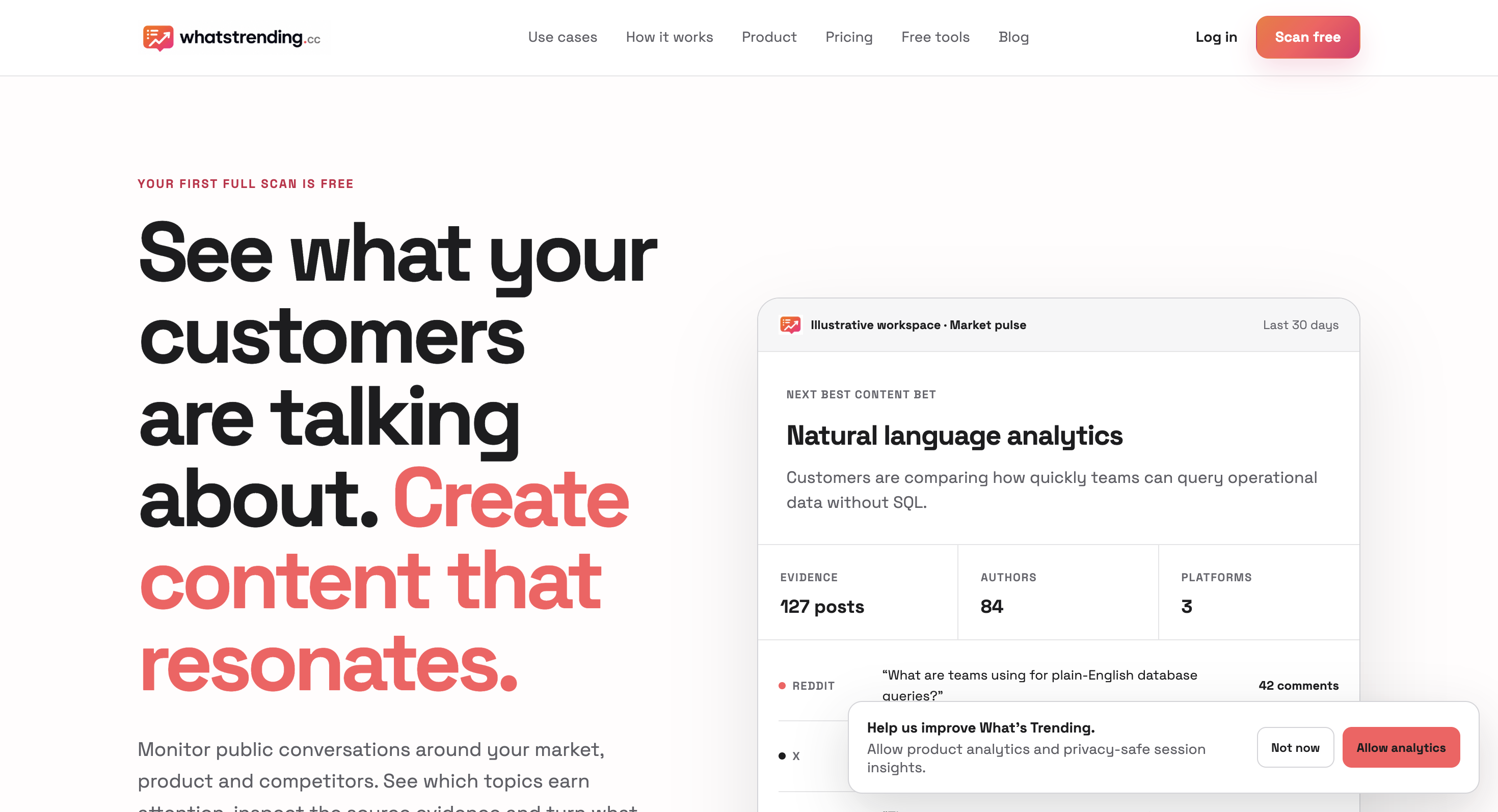
This tool helps teams understand what customers are talking about before deciding what to publish. It scans public conversations related to a market, product, or competitor set, then turns those signals into topic ideas with evidence attached. It is aimed at marketers, content teams, and researchers who want their content strategy to reflect real customer language rather than assumptions.
The main value is the connection between topic ideas and the conversations behind them. Each topic links back to original posts, allowing you to review the wording, author, and available engagement data and decide whether a signal is meaningful.
Key Features
Source-Linked Evidence
Trace each topic back to the conversations that generated it.
The tool keeps information such as:
- Original post URL
- Post text
- Author
- Available engagement metrics
This makes it possible to inspect the original discussion instead of relying only on an aggregated trend or topic label.
Public Platform Coverage
Find customer signals across multiple public platforms.
The tool tracks publicly available conversations from:
- X
This gives teams a broader view of how people discuss a market, product, or competitor set across different communities.
Engagement-Based Sorting
Compare topics using the engagement signals available on each platform.
Depending on the source, the tool can consider:
- Likes
- Comments
- Replies
- Shares
- Views
- Platform-specific scores
This helps distinguish topics with meaningful interaction from conversations that receive little attention.
Time-Based Review
Look at both recent activity and longer-term conversation patterns.
The research can cover periods ranging from days to months, making it easier to determine whether a topic is a short-lived spike or part of a broader pattern.
Content Direction
Prioritize topics based on activity and momentum.
Rather than simply collecting mentions, the tool ranks potential content topics so teams can focus on subjects with current interest and stronger signals behind them.
Built for Evidence-Based Content Research
The tool is useful for:
- Content marketers
- Marketing teams
- Content strategists
- Researchers
- SEO teams
- Social media teams
- Product marketers
- Agencies
- Businesses researching a new market
Common Use Cases
- Finding content topics based on real customer conversations
- Researching customer language
- Identifying emerging topics
- Monitoring competitor discussions
- Validating content ideas
- Comparing short-term spikes with longer-term trends
- Finding questions and problems customers discuss publicly
- Building evidence-backed content calendars
- Researching markets before launching content
- Discovering topics with growing engagement
Why It Matters
Content research can easily become disconnected from what customers are actually discussing. Keyword data and general trend reports can show that a subject exists, but they don't always provide the language, context, or evidence needed to understand why people care about it.
This tool puts the original conversations behind each topic. Because marketers can open the source posts and review the wording, author, and engagement, they can judge the strength of a signal instead of treating every mention equally.
The research process also starts with your website. The tool can suggest relevant topics and competitors before scanning public conversations, which helps when you're defining a market or testing whether your initial assumptions match what people are actually saying.
The free scan provides a practical starting point. You can run one complete market scan without a credit card and use the results to decide whether you need recurring monitoring, weekly reports, or higher-volume access through the API and agent tools.
Discover Content Opportunities From Real Customer Conversations
Scan public discussions, identify topics with current activity and momentum, and trace each opportunity back to the original conversations behind it. The tool gives marketers, content teams, and researchers a way to build content ideas around real customer signals rather than assumptions.