
AnyAPI
Route requests across 362 scraping and data APIs with automatic failover, normalized responses, and prepaid per-request billing.
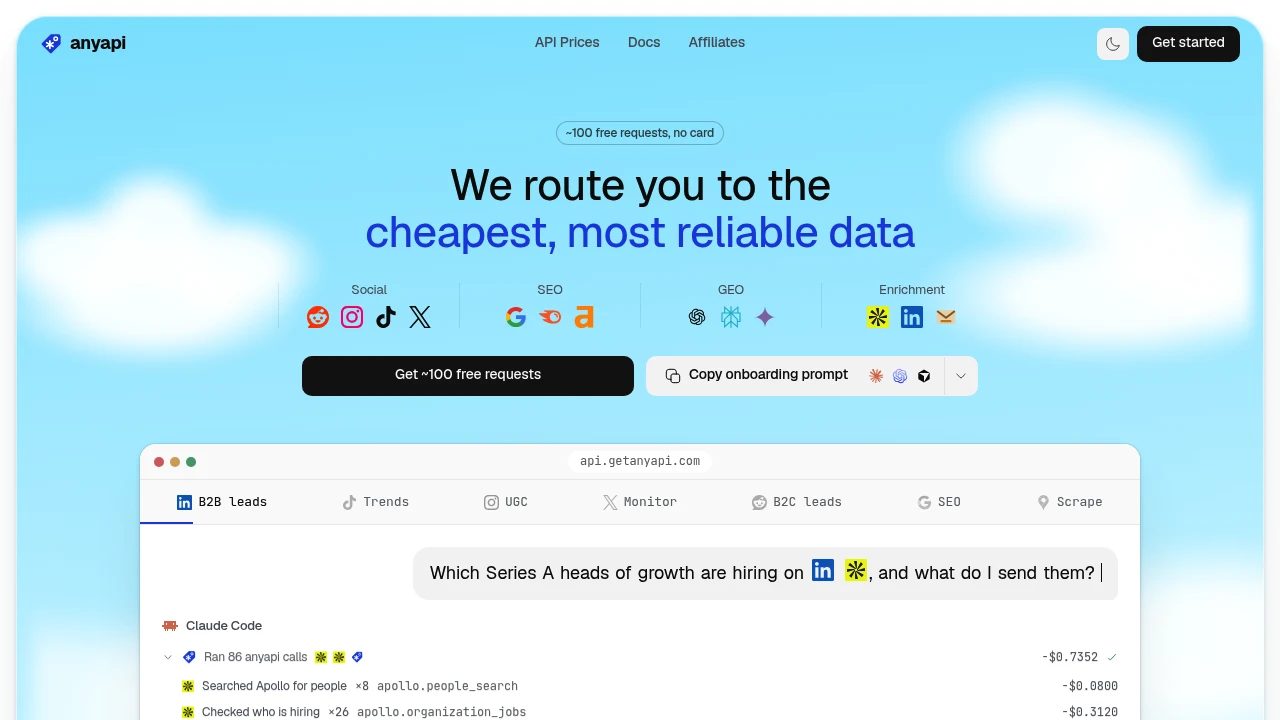
This service gives developers one place to buy and call scraping and data APIs across social, search, maps, enrichment, and lead data. Instead of managing separate vendor accounts, API keys, subscriptions, and integrations for each source, teams can access a catalog of 362 endpoints through a single account and billing system.
The platform uses a prepaid USD wallet with pay-as-you-go request pricing. New accounts can start without a card, making it possible to test real workflows before committing to a subscription. Automatic provider failover and normalized responses also help keep integrations consistent when an underlying data provider fails.
Key Features
One Key, One Wallet
Use a single account across 362 scraping and data endpoints instead of maintaining separate vendor relationships.
The prepaid USD wallet provides a straightforward usage model:
- Add funds to the wallet
- Make API requests as needed
- Pay per request
- No subscription required
- New accounts can start without a card
This gives development teams a simpler way to experiment with different data sources while keeping billing centralized.
Automatic Provider Failover
The platform is designed to route requests between providers when an underlying source breaks or returns an error.
If a provider fails, the request can be rerouted to another source behind the scenes. Failed attempts that are successfully rerouted cost $0.
This makes the platform less dependent on any single scraping provider and provides redundancy without requiring developers to build their own fallback infrastructure.
Normalized API Output
Different providers often return data in different formats. This platform normalizes responses into a consistent schema.
That means developers can build around a stable request and response structure while the underlying provider can change when necessary.
The operational model is therefore based around calling a job endpoint rather than integrating directly with one specific scraper and relying on it indefinitely.
Developer Access
The API catalog is accessible through multiple developer workflows.
Available interfaces include:
- REST APIs
- Typed SDKs
- MCP
- n8n
- CLI
This allows teams to use the same underlying catalog from traditional applications, automation workflows, command-line environments, and AI-assisted development setups.
Agent-Friendly Data Access
MCP support allows compatible clients and coding agents to call the data catalog directly.
The platform is designed for agent-driven workflows, including a skill that can onboard itself, reducing the setup required when connecting data capabilities to AI development environments.
This makes the catalog useful not only as a conventional API service but also as an infrastructure layer for AI-assisted research and automation.
Social, Search, Maps And Enrichment APIs
The catalog covers multiple types of scraping and data use cases from a single account.
Developers can access sources for:
- Social data
- Search data
- Maps data
- Enrichment
- Lead data
The broader catalog allows teams to experiment with different data sources without creating separate vendor accounts for every workflow.
Built For Developers And Data Teams
Product And Engineering Teams
Use a unified API layer instead of maintaining multiple scraping integrations and vendor accounts.
Research Teams
Build repeatable workflows around search, social monitoring, creator research, and other public data sources.
Sales And Lead Generation Teams
Support people search, lead discovery, enrichment, and email verification workflows.
Recruiting Teams
Use people search and hiring-related signals to support research and sourcing workflows.
Automation Builders
Connect data endpoints to n8n, MCP clients, CLI workflows, and custom applications.
Common Use Cases
People Search
Build workflows that search for people and relevant professional or public signals from a unified API layer.
Lead Research
Combine lead discovery and enrichment workflows without maintaining separate accounts for individual providers.
Hiring Signals
Research people and hiring-related signals as part of recruiting and talent workflows.
Email Verification
Use data APIs for email verification as part of lead and research pipelines.
Social Monitoring
Access social data for monitoring, research, and creator-focused workflows.
SEO Research
Use search and related data sources to support SEO and competitive research workflows.
Creator Research
Build research workflows around social profiles, creators, and related public data.
Pay-As-You-Go Pricing
The platform uses real-dollar, per-request pricing through a prepaid USD wallet.
There is no need to commit to a recurring subscription before testing the service. New accounts can start without a card, while successful usage is charged from the wallet.
Automatic failover also provides a clear cost advantage: when a request fails and is successfully rerouted, the failed attempt costs $0.
Why It Matters
The main value is operational simplicity.
Instead of selecting one scraping provider for every workflow and building your integration around the assumption that it will remain reliable, you can call a unified job endpoint that can move between providers when necessary.
The combination of one API key, one prepaid wallet, automatic failover, and normalized output reduces the operational overhead of managing multiple data vendors. Developers can keep their integration consistent while the platform handles provider selection and redundancy behind the scenes.
For teams building lead generation, research, recruiting, SEO, social monitoring, or agent-driven workflows, this creates a practical way to access a broad scraping and data API catalog while paying only for the requests they actually make.
Build Data Workflows With One API Layer
Access 362 scraping and data endpoints through one account, one wallet, and a consistent API experience. With automatic provider failover, normalized responses, REST and SDK access, MCP and automation integrations, and pay-as-you-go request pricing, the platform gives developers a simpler way to build data workflows without managing a separate vendor stack for every source.


