
APort
AI agent passport and control plane with pre-action authorization, guardrails, and signed audit for coding agents and repo automation.
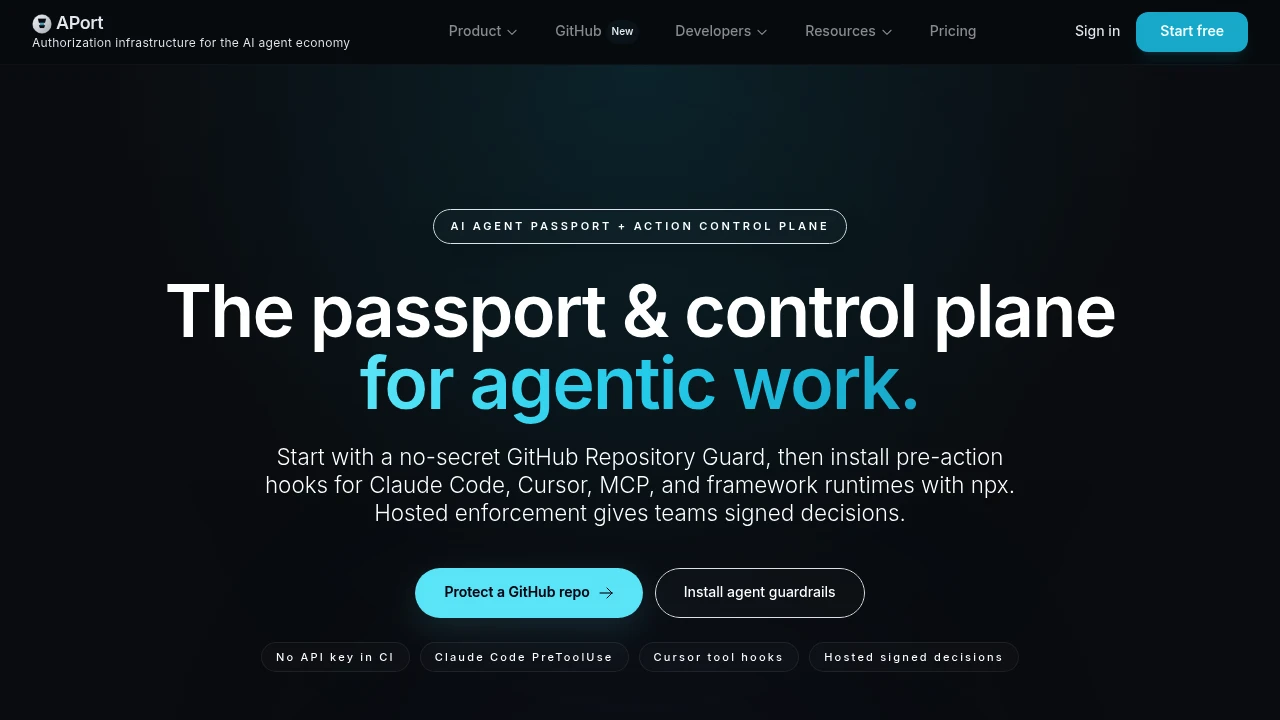
APort is an AI agent identity and control layer for teams that use coding agents, workflow automation, and MCP-connected tools. It adds controls before actions happen, rather than relying only on prompt instructions or reviewing logs after execution.
The platform is built around four core components: passport, policy, guardrail, and proof. Passports define an agent's identity and capabilities, policies determine which actions are permitted, guardrails monitor native hooks and repository changes, and proof creates signed records of decisions for review and auditing.
Key Features
Pre-Action Authorization
Control agent actions before they are executed.
APort can block risky commands, file access, MCP tool calls, and merge attempts before they complete, giving teams a way to enforce rules at the point of action.
Repository Guard
Monitor protected areas of GitHub repositories and detect workflow changes.
This helps teams add additional controls around sensitive files, repository permissions, and changes that could affect development workflows.
Signed Decisions
Create hosted, tamper-evident records of agent decisions.
Instead of relying only on conventional logs, APort records signed decisions that can be reviewed later for auditing and accountability.
Framework Support
APort works across a broad range of coding, agent, and application frameworks.
Supported environments include:
- Claude Code
- Cursor
- MCP
- LangChain
- LangGraph
- CrewAI
- OpenAI
- FastAPI
- Express
- Next.js
- Python
- Node.js
GitHub OIDC Enforcement
Support CI workflows without relying on stored secrets.
GitHub OIDC enforcement provides another layer of control for teams managing automated development and deployment workflows.
Built For AI Agent Governance
APort provides deterministic controls around what AI agents can do across development and automation environments.
Key benefits include:
- Control actions before execution
- Limit file and repository access
- Restrict MCP tool usage
- Protect sensitive repository paths
- Record signed decisions
- Control merge attempts and destructive commands
- Support multiple agent and development frameworks
Built For
- Developer teams using coding agents
- AI engineering teams
- DevOps teams
- Security teams
- Teams using MCP-connected tools
- Organizations running workflow automation
- Regulated environments
- Teams managing sensitive code and repositories
Common Use Cases
Controlling Coding Agents
Set deterministic rules around commands, file access, repository permissions, and other actions performed by coding agents.
Protecting Repositories
Monitor protected paths and workflow changes in GitHub before potentially risky changes are allowed through.
Securing MCP Workflows
Control which MCP tool calls agents can make and prevent unauthorized tool access before execution.
Managing Agent Permissions
Use passports and policies to define agent identity, capabilities, and permitted actions.
Auditing Agent Decisions
Create signed records of decisions so teams can review what an agent was allowed to do and why.
Regulated AI Workflows
Add pre-action controls and auditability to environments where agent behavior needs to be deterministic and reviewable.
Why It Matters
AI agents increasingly interact directly with codebases, repositories, tools, and automated workflows. Prompt instructions can define intended behavior, but they don't necessarily provide deterministic enforcement when an agent attempts an action.
APort focuses on the action itself. Its passport, policy, and guardrail system can control commands, file access, MCP calls, repository changes, and merge attempts before they happen, while the proof layer provides signed records for later review.
It can also complement existing IAM, vaults, sandboxes, and runtime monitoring tools by adding a control layer specifically around the actions an agent attempts to perform.
Control AI Agent Actions Before They Execute With APort
Give AI agents defined identities, enforce policies before actions happen, protect repositories and tools, and maintain signed evidence of their decisions.


