
doloc
Sends localization files through a translation API and returns updated targets in the same run, while preserving structure and existing translations.
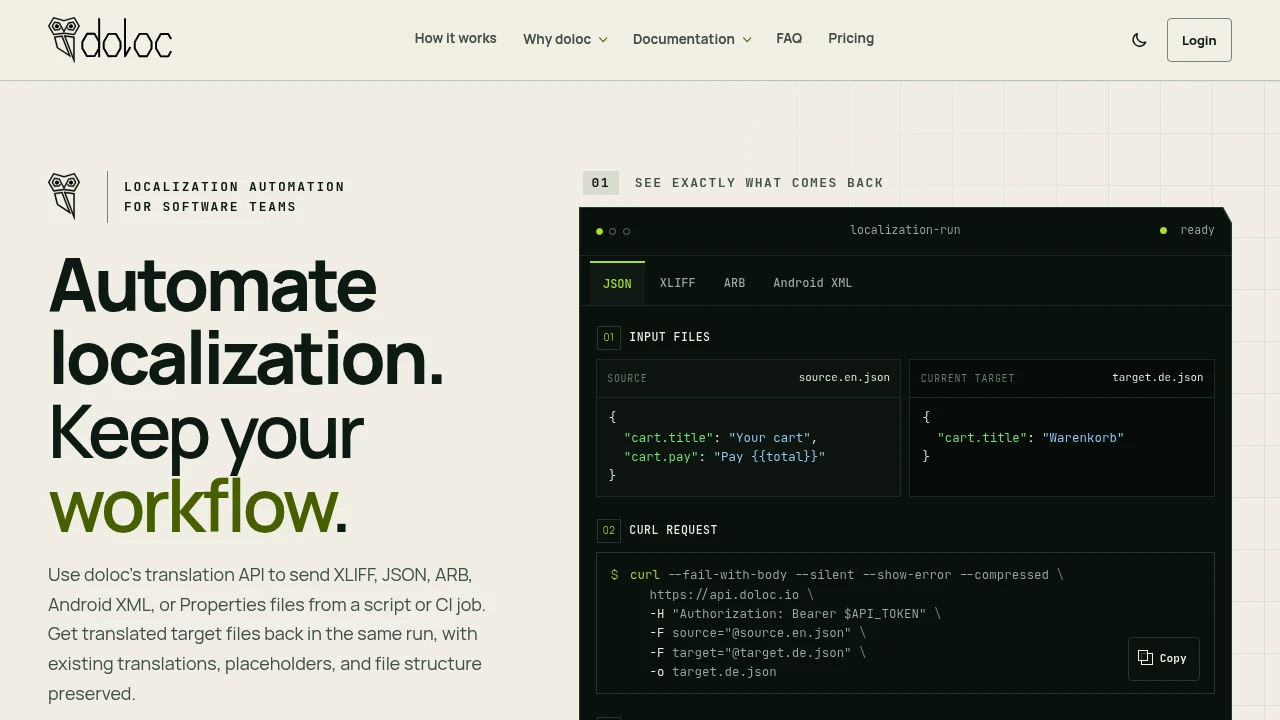
doloc is a developer-focused localization tool for software teams that keep translation files inside their code repository. It lets teams send source and target localization files through a translation API and receive updated target files in the same workflow, making localization easier to fit into scripts, CI jobs, and existing release processes.
The platform works with common software localization formats including XLIFF 1.2, XLIFF 2.0, JSON, ARB, Android XML, and Properties files. It preserves the existing file structure, placeholders, and translations, allowing teams to fill missing strings without unnecessarily changing content that is already translated.
Key Features
Synchronous Translation API
Send source and target files from a script or CI job and receive the translated target files within the same request, keeping the workflow straightforward.
Repository-Native Localization
Keep localization files inside the existing repository so extraction, testing, code review, diffs, and release controls continue working through the same development workflow.
Multiple Localization Formats
Supports XLIFF 1.2, XLIFF 2.0, JSON, ARB, Android XML, and Properties files, allowing teams to work with the formats already used by their applications.
Structure Preservation
Maintains the original file structure and placeholders while adding translations, reducing the risk of breaking references or formatting during localization.
Existing Translation Context
Uses translations already present in the target file to help preserve terminology and style, making new strings more consistent with existing UI copy.
Same-Format Output
Returns translated files in the same format as the files used by the application, so the output can go directly back into the repository and existing workflow.
Missing String Translation
Focuses on filling untranslated or missing strings without rewriting translations that are already present, making it suitable for ongoing product localization.
Built for Repository-Based Localization
doloc is designed around the idea that the code repository should remain the source of truth for localization. Instead of moving translation work into a separate workspace, teams can integrate translation directly into scripts, CI pipelines, and their existing software delivery process.
This makes it useful for products where UI copy changes frequently. Developers can update source strings, run their existing localization workflow, review the resulting file changes, and continue through the same testing and release process used for the rest of the application.
Built For
- Software developers
- Engineering teams
- SaaS companies
- Product teams
- Teams using Git-based workflows
- CI/CD-driven development teams
- Developers managing application localization
Common Use Cases
- Translating new UI strings
- Filling missing translations
- Running localization from CI jobs
- Automating translation through scripts
- Keeping localization files in Git
- Preserving existing terminology across translations
- Reviewing translation changes through repository diffs
- Updating localized application content during releases
Why It Matters
The main value of doloc is that localization can stay inside the development workflow instead of becoming a separate operational process. Teams can keep their translation files in the repository, automate translation through an API, and continue using existing checks and release controls.
Its preservation of structure, placeholders, and existing translations also makes it suited to ongoing software localization where files are repeatedly updated. Developers can automate routine UI translation while keeping legal, regulated, ambiguous, or brand-critical copy available for additional human review.
Keep Localization in Your Repository
doloc connects software localization directly to existing development workflows. With synchronous API processing, support for common localization formats, and preservation of existing file structure and translations, it gives development teams a file-in, updated-file-out workflow for keeping application content translated without moving localization into a separate platform.


