
Kener
Open-source status pages and uptime monitoring with incident management, maintenance scheduling, and subscriber notifications.
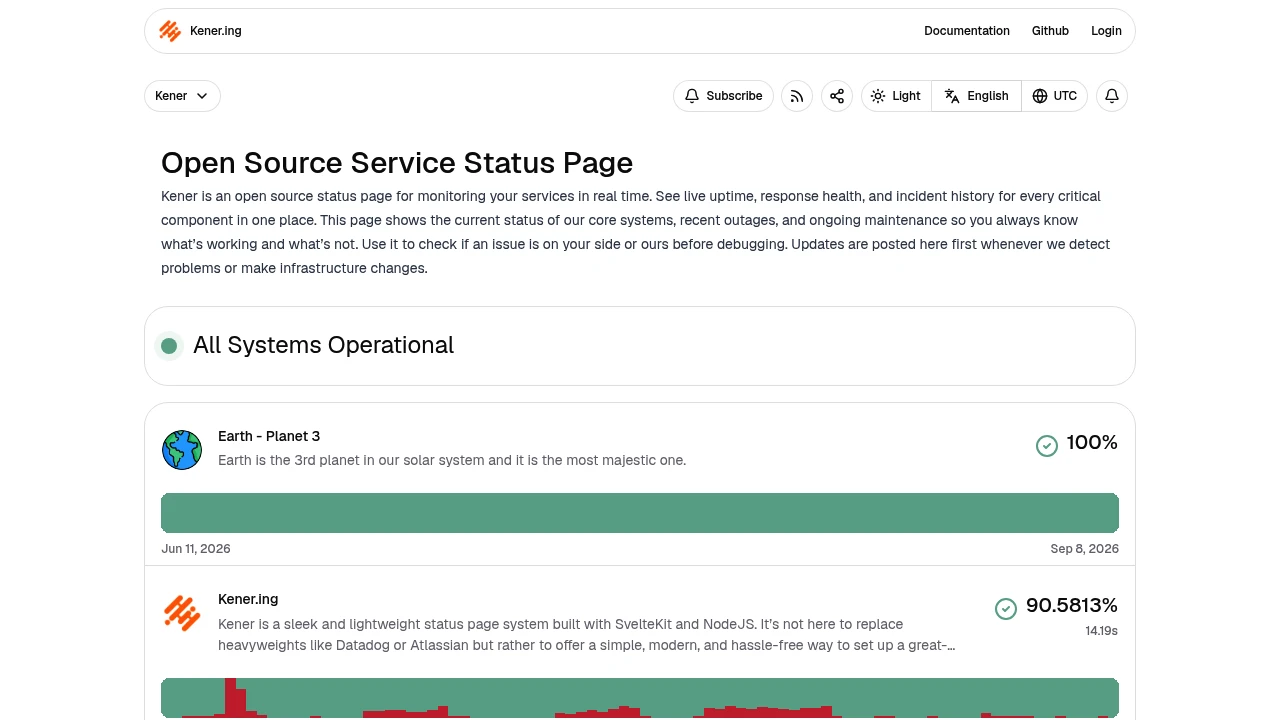
Kener is a free, open-source status page and uptime monitoring platform for teams that want to publish service health, monitor availability, and manage incidents from one place. It provides a self-hosted alternative to hosted monitoring suites, giving teams control over their status page and the operational workflows behind it.
The platform combines public status pages with uptime monitoring, incident management, maintenance scheduling, and subscriber notifications. With support for 11 service types and a Docker-ready deployment, Kener is suited to smaller teams and open-source projects that want a straightforward way to communicate service health without stitching together multiple tools.
Key Features
Public Status Pages
Create a public-facing status page where users can check the health of your services.
Status pages provide a central place to communicate whether services are operating normally, experiencing an issue, or undergoing planned maintenance.
This gives customers and users a dedicated source of truth when they want to know whether a service is currently available.
Uptime Monitoring
Monitor services for availability issues and surface problems when they occur.
Uptime monitoring works alongside the public status page, allowing teams to track service health internally while also communicating relevant incidents externally.
Incident Management
Record and manage service outages from within the same platform as your status page and monitoring.
Instead of maintaining incident information separately from the public status page, teams can use one system to manage incidents and communicate service disruptions.
Maintenance Scheduling
Schedule and publish planned maintenance alongside live service health information.
This allows teams to distinguish between unexpected outages and planned work, giving users visibility into upcoming maintenance before it affects service availability.
Subscriber Notifications
Keep subscribers informed when service status changes.
Notifications provide a way to communicate important updates to people who want to stay informed about outages, incidents, or other changes to service health.
11 Service Types
Kener supports 11 service types, allowing teams to represent different kinds of services and endpoints within their monitoring setup.
This provides flexibility when monitoring a range of infrastructure or application services rather than treating every check as the same type of endpoint.
Docker-Ready Deployment
Kener is designed for teams that want a straightforward self-hosted deployment path, with Docker support available for deployment.
Self-hosting gives teams greater control over where their monitoring and status-page infrastructure runs and avoids depending on a hosted monitoring provider for the core system.
Open Source
Kener is free and open source, making it suitable for teams that prefer software they can inspect, deploy, and control themselves.
The project uses Svelte and TailwindCSS, providing a modern frontend foundation for the monitoring and status-page interface.
Built For Teams & Open Source Projects
Kener is designed for organizations that need service monitoring and public incident communication without adopting a paid hosted monitoring suite.
- Small teams managing application and service availability
- Open source projects publishing public service health
- Developers looking for a self-hosted monitoring solution
- Operations teams managing incidents and maintenance
- SaaS teams communicating outages to customers
- Self-hosting users who want control over their monitoring infrastructure
Common Use Cases
SaaS status pages: Give customers a public location to check application and service health.
Uptime monitoring: Track services and identify availability problems.
Incident communication: Manage outages and communicate service disruptions through the same platform.
Planned maintenance: Publish scheduled maintenance so users know about upcoming service interruptions.
Subscriber updates: Keep interested users informed when service status changes.
Self-hosted monitoring: Run a status page and uptime monitoring system under your own infrastructure instead of relying on a hosted monitoring suite.
Open source service monitoring: Provide users with a transparent public status page while retaining control over the underlying platform.
Why It Matters
A service status workflow often requires several separate pieces: uptime monitoring, a public status page, incident tracking, maintenance communication, and notifications. Managing these independently can create unnecessary operational overhead and make it harder to keep public information synchronized with what is happening internally.
Kener brings these functions together in one open-source platform. Its combination of status pages, uptime monitoring, incident management, maintenance scheduling, and subscriber notifications provides a more unified approach, while Docker support makes self-hosted deployment practical for teams that want control over their setup.
Monitor Services & Keep Users Informed
Use Kener to monitor uptime, publish service health, manage incidents, schedule maintenance, and notify subscribers from one open-source platform. With Docker-ready deployment and support for 11 service types, it provides a straightforward option for teams that want to own their status page and monitoring infrastructure.


