
Markdown Anything
API that converts documents, images, and audio into clean Markdown for LLMs, RAG, and agents.
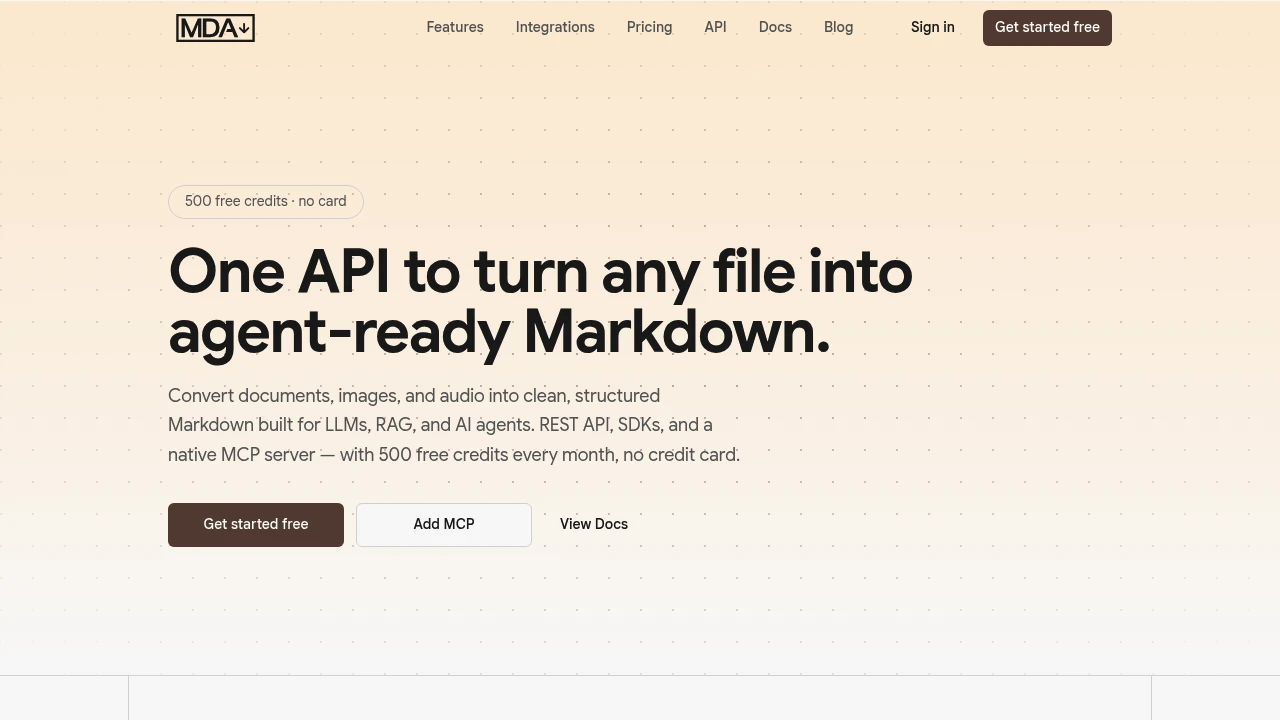
This API converts files into structured Markdown that AI systems can read and work with more effectively. It is designed for developers building LLM applications, RAG pipelines, and agent workflows where preserving document structure matters as much as extracting the underlying text.
It supports more than 20 file types, including PDFs, Word documents, spreadsheets, slide decks, HTML, CSV, JSON, XML, images, and audio. For scanned documents and screenshots, OCR extracts text while preserving useful structure, including tables, nested lists, and multi-column layouts.
Key Features
REST API
Convert files programmatically through a standard REST API. This makes the conversion layer easy to integrate into existing applications, scripts, and data-processing pipelines.
SDKs
Use SDKs for common development workflows instead of building every integration directly around HTTP requests. This makes it easier to add file conversion to applications that already have their own ingestion or processing logic.
Native MCP Server
Connect file conversion directly to AI tools through a native MCP server. It supports workflows with tools such as Claude Desktop, Cursor, and Claude Code, allowing agents to fetch and convert files without requiring manual copy-paste.
20+ File Types
Handle a broad range of document and media formats, including:
- Word documents
- Spreadsheets
- Slide decks
- HTML
- CSV
- JSON
- XML
- Images
- Audio
This provides one conversion layer for different types of files entering an AI workflow.
OCR for Scanned Files
Use OCR when the source is a scanned document or screenshot. The conversion process extracts readable text while attempting to retain the document's useful structure.
Structure Preservation
Convert files into Markdown without flattening everything into a single block of text. The API detects and preserves structures such as headings, tables, nested lists, and multi-column layouts where supported.
Semantic Markdown Output
The output is designed around how AI systems consume documents. Preserving hierarchy and document structure can make the resulting Markdown easier to chunk, search, retrieve, and pass into downstream LLM workflows.
Async Webhooks
Run conversions as background processes using asynchronous webhooks. This is useful when file processing should happen independently of the application's main request flow.
Token Optimization
Optimize converted output when reducing context size is important. This can help teams manage the amount of document content passed into AI models.
Audio Transcription
Convert audio alongside documents and other file types. This extends the same ingestion workflow to spoken content that needs to become usable text for downstream AI systems.
Built For AI File Ingestion
This API is built for teams that need a consistent conversion layer across applications, scripts, RAG pipelines, and AI agents. Instead of building separate extraction workflows for different file formats, developers can use the same service to turn varied source material into structured Markdown.
Common Use Cases
- Building RAG document ingestion pipelines
- Preparing files for LLM applications
- Giving AI agents access to document content
- Converting PDFs into structured Markdown
- Processing Word documents and spreadsheets
- Extracting text from scanned documents
- Converting screenshots with OCR
- Preserving tables and nested lists during extraction
- Processing multi-column documents
- Adding file conversion to an MCP workflow
- Transcribing audio for AI applications
- Reducing token usage in document-based AI workflows
Pricing
The service offers a free tier with 500 credits per month and does not require a credit card to get started. This provides a way to test file conversion and AI ingestion workflows before committing to a paid plan.
Why It Matters
Basic text extraction can make complex documents difficult for AI systems to use effectively because headings, tables, lists, and other relationships can disappear during conversion. This API focuses on preserving those structures while producing Markdown that can be passed into LLM, RAG, and agent workflows.
The main value is the combination of broad file support and semantic output. Developers can process documents, images, spreadsheets, slide decks, and audio through one conversion layer while retaining structure that makes the resulting content more useful for chunking, search, retrieval, and AI processing.
Turn Files Into AI-Ready Markdown
Convert more than 20 file types into structured Markdown with OCR, semantic structure preservation, REST APIs, SDKs, MCP support, webhooks, and audio transcription for modern AI workflows.


