
Vibe Code Pipeline
An interactive encyclopedia and lab for AI agents, prompts, and multi-agent pipelines with simulations, guides, and a prompt library.
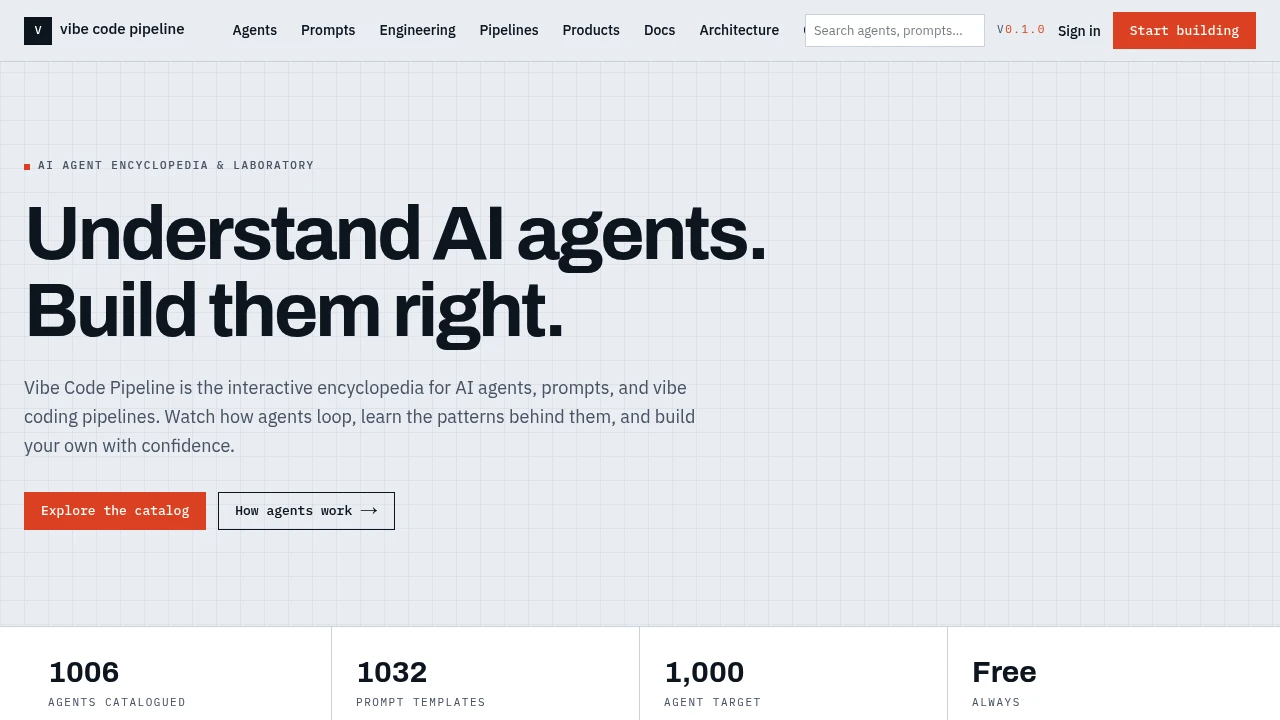
Vibe Code Pipeline is an educational platform for developers, product managers, founders, and teams who want to understand how AI agents work before building and deploying them. It combines an agent encyclopedia, visual simulations, architecture diagrams, guides, a prompt library, and a build-oriented agent builder so you can study how agents plan tasks, use tools, manage memory, and coordinate with other agents.
The platform focuses on seeing agent workflows rather than only reading about them. Each agent entry includes a step-through simulation covering the core loop of input, planning, tool calls, memory, and output. The simulations are conceptual rather than live model runs, keeping the focus on understanding agent structure and behavior without requiring API keys or deployment.
Key Features
Agent Encyclopedia
Explore a catalog of more than 1,000 AI agent entries covering different agent patterns and approaches.
Each entry is designed to help users understand how an agent system is structured and how it approaches a task, making the encyclopedia useful for both learning and design research.
Visual Agent Simulations
Step through conceptual simulations to see how an agent processes a task.
The simulations illustrate the agent loop:
- Input
- Planning
- Tool calls
- Memory
- Output
Because the simulations are conceptual rather than live model executions, you can focus on understanding the underlying workflow without waiting for model calls or configuring an AI provider.
Agent Architecture Diagrams
Explore visual representations of agent architectures, including both single-agent and multi-agent setups.
These diagrams make it easier to reason about how components interact, particularly when comparing a straightforward agent workflow with systems involving multiple coordinated agents.
Prompt Templates
Access a library of prompt templates covering common AI agent patterns.
The prompt library provides practical starting points for developers and builders who want to translate an agent concept into a structured prompt rather than starting from a blank page.
Guides & Agent Glossary
Learn the terminology and concepts behind agent-based systems through guides and a glossary covering 100+ terms.
This is particularly useful for people who understand AI applications but want to develop a clearer distinction between conventional chatbots and systems that can plan, use tools, maintain task state, or coordinate multiple steps.
Agent Builder
Turn selected agent patterns into a prompt and blueprint through the built-in agent builder.
The workflow helps you move from studying an agent pattern to drafting your own system structure without requiring live model execution.
- Select relevant patterns
- Generate an agent prompt
- Generate an architecture blueprint
- Explore the resulting structure
- No API keys required
- No deployment required
This makes the builder useful during the design and exploration stage, before committing engineering resources to implementation.
Free Access
The core learning and exploration resources are available for free.
Free access includes:
- Agent encyclopedia
- Visual simulations
- Guides
- Glossary
- Prompt library
- Community
- Agent builder resources
This allows users to explore agent architectures and patterns without first setting up infrastructure or paying for model usage.
Community Contributions
The catalog can grow through community submissions while retaining a curated approach.
Submitted material goes through team review before being published, helping maintain a level of consistency as new agent patterns and examples are added to the platform.
Built For Developers & Agent Builders
Vibe Code Pipeline is designed for people who need to understand agent systems before implementing them.
- Developers exploring agent architectures and tool use
- Product managers evaluating agent-based product ideas
- Founders researching how to structure AI products
- AI builders comparing different agent patterns
- Engineering teams discussing single-agent and multi-agent designs
- Learners trying to understand the difference between chatbots and agent systems
Common Use Cases
Learning AI agents: Study agent patterns, terminology, architectures, and workflows through a combination of written explanations and visual simulations.
Agent architecture research: Compare single-agent and multi-agent approaches before deciding how a system should be structured.
Prompt development: Use existing templates as starting points for common agent patterns.
Product planning: Explore how agents could handle planning, tool use, memory, verification, and orchestration before implementation.
Vibe coding workflows: Research agent designs and create preliminary blueprints for products built around AI-assisted development.
Team discussions: Use simulations and architecture diagrams to give teams a shared way to reason about how an agent system should behave.
Pre-implementation design: Build a prompt and blueprint without API keys or deployment, allowing teams to explore an architecture before committing to live model calls.
Why It Matters
Understanding an AI agent is different from understanding a chatbot. Agents can involve planning, tool calls, memory, task state, verification, and coordination, which makes their architecture harder to reason about from text descriptions alone.
Vibe Code Pipeline addresses this by combining explanation with inspection. You can study an agent pattern, step through a conceptual simulation, examine its architecture, and then use the builder to turn selected patterns into a prompt and blueprint. This provides a practical way to think through agent behavior before writing production code or connecting live models.
Understand AI Agents Before You Build Them
Explore more than 1,000 agent patterns, step through visual simulations, learn the terminology, study single-agent and multi-agent architectures, and use prompt templates to develop your own designs. With a free encyclopedia, simulation library, community, and builder that requires no API keys or deployment, Vibe Code Pipeline provides a practical environment for understanding agent systems before they ship.


