
Zuperix
A digital asset management platform for creative teams that uses AI to search, tag, deduplicate, and manage images, videos, and files.
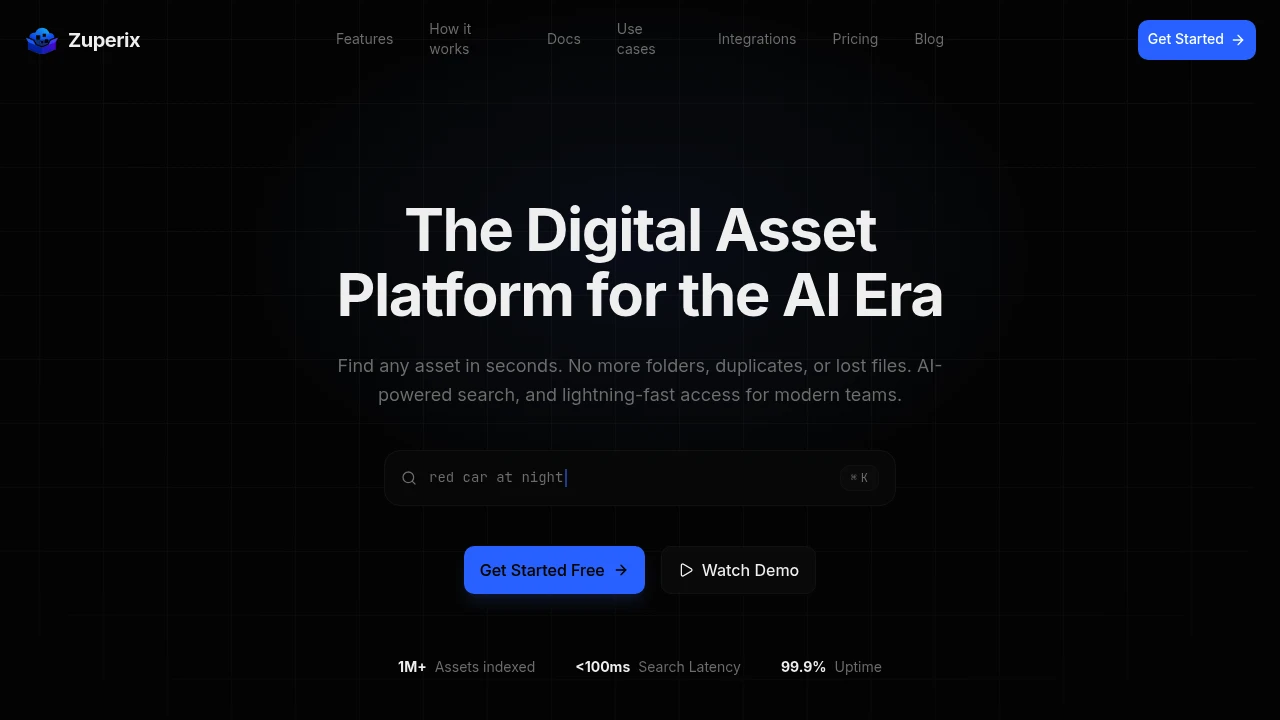
Zuperix is a digital asset management platform for teams that need to keep large media libraries searchable, organized, and easy to manage. It supports images, videos, PDFs, and other files, helping creative, marketing, content, and enterprise teams spend less time searching for the right asset and more time using it.
The platform focuses on meaning-based asset discovery, going beyond filenames and basic folder structures. Teams can search in natural language, run structured queries, use reverse image search, and find visually similar files. AI-generated tags, face recognition, OCR, and video transcription make more of the library searchable, while duplicate detection helps keep collections clean from the moment assets are uploaded.
Key Features
Natural Language Asset Search
Find assets by describing what you are looking for in everyday language.
Instead of relying only on filenames or manually browsing folders, teams can search their library based on the meaning and content of an asset.
- Plain-language search
- Structured queries
- Meaning-based discovery
- Visually similar asset search
- Reverse image search
This makes large libraries easier to navigate when users do not know the exact filename or location of an asset.
AI-Powered Asset Tagging
Make media easier to discover by automatically enriching assets with metadata.
Zuperix can generate AI tags that help organize and retrieve content across large collections, giving teams more searchable context without requiring every asset to be manually tagged.
Face Recognition
Find people within image libraries using face recognition.
The platform can recognize and tag people in images, making it easier to locate photos featuring specific individuals across large media collections.
OCR And Text Extraction
Make text inside images and documents searchable.
OCR and text extraction work with sources such as:
- Screenshots
- PDFs
- Images
- Other documents containing text
This allows teams to discover assets based on the information contained inside the file, rather than only its filename or manually entered metadata.
AI Video Transcription
Turn video content into searchable transcripts.
Zuperix provides AI video transcription with caption and transcript export, making spoken content easier to find and reuse.
Transcribed video content can also contribute additional searchable context to large media libraries.
Duplicate Detection
Keep asset libraries cleaner by identifying duplicate files.
Duplicate detection is available both during upload and through a dedicated duplicate manager, helping teams prevent unnecessary copies from accumulating and giving them a separate workflow for cleaning existing collections.
Advanced Metadata
Organize assets with structured information beyond automatically generated tags.
Teams can use:
- Custom fields
- Tags
- Categories
- Advanced metadata
This provides a structured foundation for teams that need consistent asset organization across departments, campaigns, projects, or content libraries.
Webhooks And Automation
Connect asset activity to external systems through modular webhooks.
Webhooks can send asset-related events to external servers or tools such as Slack, allowing teams to build workflows around changes in their media library.
This makes asset management part of broader operational workflows rather than an isolated repository.
REST API
Expose asset operations to applications and internal workflows through the REST API.
The API supports operations including:
- Asset uploads
- Asset search
- Metadata updates
- Asset removal
This gives teams a programmatic way to integrate their DAM with existing systems and automate recurring asset operations.
MCP Server Support
Zuperix also supports MCP server integration for AI agents and workflow automation.
Tagged and extracted assets can be exposed in a form that supports AI-driven retrieval and other workflows, including use cases involving fine-tuning.
This creates a bridge between the asset library and AI tools that need structured access to media and its associated metadata.
Built For Creative And Content Teams
Creative Teams
Keep large collections of visual assets organized and searchable through natural-language discovery, visual similarity, metadata, and duplicate management.
Marketing Teams
Find campaign imagery, documents, videos, and other marketing assets without relying entirely on filenames or folder structures.
Content Teams
Search across images, PDFs, screenshots, and video content using extracted text, tags, transcripts, and other metadata.
Enterprise Teams
Give larger organizations a structured DAM with APIs, webhooks, metadata controls, and AI integration capabilities for connecting asset operations to broader systems.
Common Use Cases
Finding Assets By Description
Search for an asset using everyday language when you do not know its filename or exact location.
Searching Visual Libraries
Use reverse image search and visually similar asset discovery to locate related images across a large collection.
Making Archived Content Searchable
Use OCR, AI tags, face recognition, and video transcripts to add searchable information to existing media libraries.
Cleaning Duplicate Libraries
Detect duplicates during upload and use the duplicate manager to clean up existing collections.
Connecting DAM Workflows
Use the REST API and webhooks to connect asset uploads, searches, metadata changes, and other events with external applications and workflows.
AI Asset Retrieval
Expose structured, tagged, and extracted asset information to AI workflows through MCP and related integrations.
Search, Structure, And Automation In One DAM
Traditional digital asset management often depends heavily on filenames, folders, and manually maintained metadata. Zuperix makes search, structure, and automation central to the asset management workflow.
By combining natural-language search, reverse image search, visual similarity, AI tagging, face recognition, OCR, video transcription, duplicate detection, advanced metadata, webhooks, REST APIs, and MCP support, it gives teams multiple ways to find, organize, and work with their media libraries.
Why It Matters
Large media libraries become difficult to manage when useful assets are buried behind inconsistent filenames, missing metadata, duplicate files, or content that cannot be searched directly.
Zuperix addresses those problems by making the contents and meaning of assets part of the search experience. At the same time, its API, webhooks, and MCP support allow asset operations to connect with external tools and AI workflows.
The result is a DAM designed not only to store assets, but to make them easier to discover, structure, and use across the organization.
Make Your Asset Library Searchable
Bring images, videos, PDFs, and other files into a DAM built around intelligent discovery and automation. With natural-language search, AI enrichment, duplicate detection, advanced metadata, REST APIs, webhooks, and MCP support, Zuperix helps teams turn large media libraries into structured, searchable asset collections.


